




Is Creatine Safe for Women UK? The Evidence-Backed 2026 Guide
Creatine has spent thirty years being marketed almost exclusively to men lifting heavy things in gyms. The tubs were
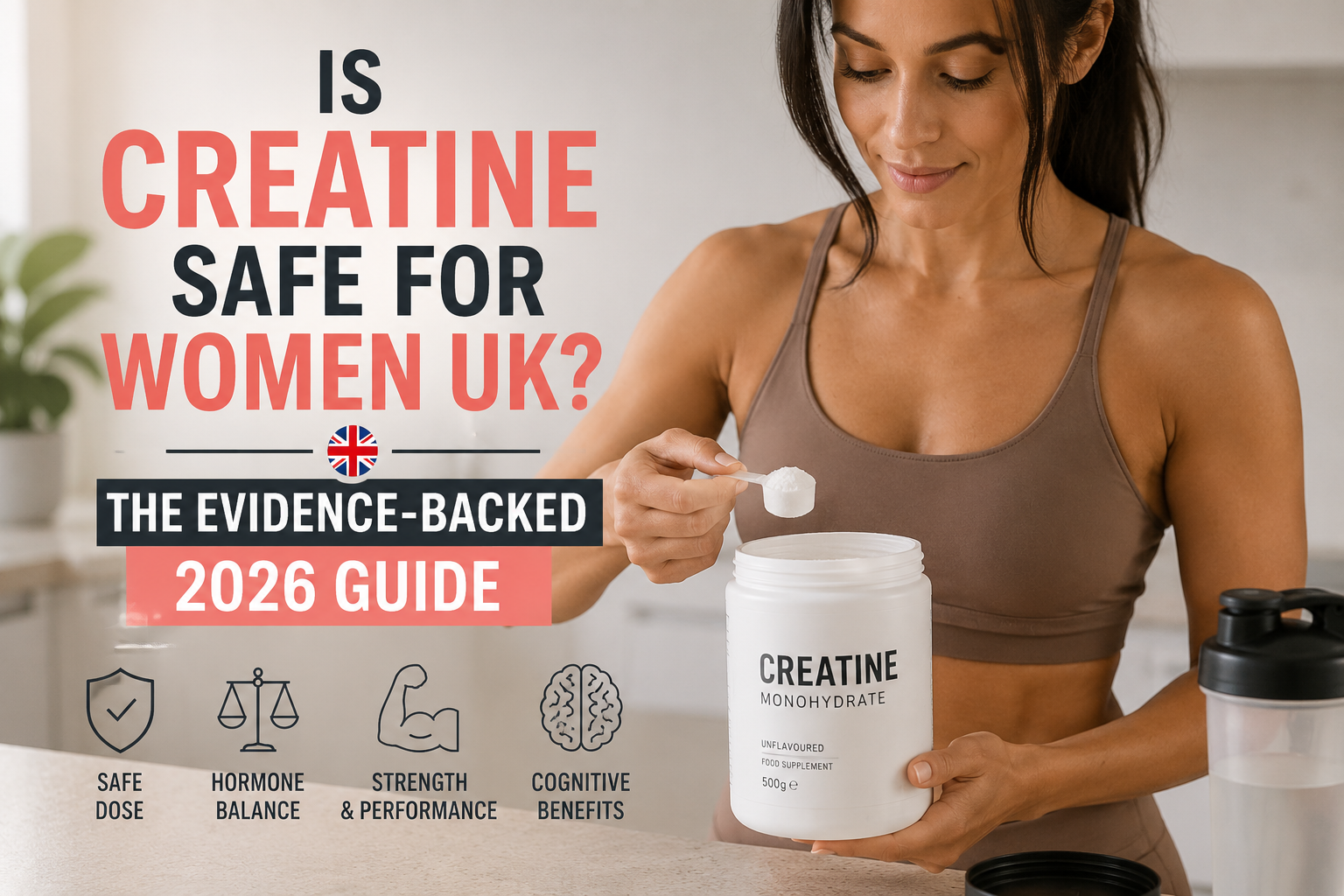
Creatine has spent thirty years being marketed almost exclusively to men lifting heavy things in gyms. The tubs were black. The fonts were aggressive. The messaging was about getting bigger, faster, stronger — and it was aimed squarely at a male audience.
That era is ending.
In 2026, creatine is one of the most discussed supplements in women’s health — not because it became a new product, but because the research finally caught up with the question most women were never asked in the first place: what does creatine actually do in the female body? The answer is considerably more interesting than the gym-bro marketing ever suggested.
This article is for informational purposes only and does not constitute medical advice. Consult your GP before starting any new supplement if you have a pre-existing health condition.
Quick Answer
Yes — creatine is safe for women and is considered one of the most well-researched supplements available. The International Society of Sports Nutrition (ISSN) classifies it as safe for both short and long-term use with no significant adverse effects at recommended doses. Women naturally have 70–80% lower creatine stores than men, which means supplementation often delivers more noticeable benefits. Research supports benefits for muscle strength, bone density, cognitive function, mood, and menopausal health — not just athletic performance.
What Is Creatine?
Creatine is a naturally occurring compound your body produces in the liver and kidneys, storing it primarily in muscle tissue. It is also found in foods — red meat and oily fish are the richest dietary sources, which is one reason vegetarians and vegans tend to have lower creatine stores than meat-eaters.
Its primary job is to support ATP production — ATP being adenosine triphosphate, the energy currency your cells use during short bursts of intense activity. Think sprinting, lifting, jumping, climbing stairs fast. When your muscles need quick energy, creatine is what enables the first few seconds of that effort.
That is the basic biology. What makes it interesting for women specifically is what happens when you supplement creatine in a body that starts with significantly lower stores than the male body most of the research was conducted on.
Why Women Start With a Creatine Deficit
Women naturally have 70–80% lower creatine stores than men. This is not a minor difference — it is a fundamental gap in baseline levels that has significant implications for what supplementation can deliver.
The reasons are multiple. Women generally have less total muscle mass than men, and creatine is primarily stored in muscle. Women also tend to consume less dietary creatine because they eat less red meat on average. Vegetarian and vegan women — a growing proportion of UK women — have lower creatine stores still.
The practical implication, confirmed by multiple research reviews, is that women often see more noticeable benefits from creatine supplementation than men — not because the supplement works differently, but because the starting deficit is larger. You are not enhancing an already-sufficient level. You are restoring something that was genuinely low.
Is Creatine Safe for Women?
Also read Melatonin Dosage Guide UK: How Much Is Safe, By Age
Yes. The safety record is one of the strongest of any supplement on the market.
The ISSN position stand on creatine — one of the most cited documents in sports nutrition — concludes that long-term creatine supplementation at 3–5g per day is safe for healthy adults, with no consistent evidence of harm to kidney function, liver, hair, or hormones.
A comprehensive safety review found that creatine supplementation is not associated with meaningful risks of weight gain, liver damage, kidney complications, or serious side effects in healthy individuals.
The NHS guidance on supplements classifies creatine as a low-risk option for healthy people when used at sensible doses. It is not on any restricted or controlled list in the UK.
The kidney concern: This is the most common question and deserves a direct answer. Creatine raises levels of creatinine in the blood — a substance measured in routine kidney function tests. In healthy people, this elevation is benign and does not indicate kidney damage. However, because creatinine is used as a marker for kidney health, it can make it harder to monitor kidney function in people who already have kidney disease. If you have chronic kidney disease, discuss creatine with your GP before starting.
The “bulking” myth: Women will not develop extreme muscle mass from taking creatine. Muscle hypertrophy at that scale requires high testosterone levels, which women do not naturally have in sufficient quantities. What creatine does is support lean muscle retention and modest strength gains — not a physique transformation.
What Are the Benefits of Creatine for Women?
This is where the research becomes genuinely interesting — because the benefits are not limited to the gym.
Muscle Strength and Physical Performance
The most established benefit. Research consistently shows improved performance in high-intensity, short-duration activities — strength training, HIIT, sprinting. Women who take creatine alongside resistance training build strength more efficiently and recover faster between sessions.
A 2025 study found that 5g of creatine monohydrate daily, combined with twice-weekly strength training over 14 weeks, improved lower-body strength, sleep quality, and body composition in perimenopausal and postmenopausal women. The physical performance benefit is real and well-supported.
Bone Density
This is one of the most important benefits specifically for women, and one that receives almost no attention in mainstream creatine marketing.
Creatine helps you train harder and build more muscle — both of which place beneficial mechanical loading on bones, stimulating bone formation. Beyond that mechanical effect, there is early evidence of a direct stimulatory effect on osteoblasts, the cells responsible for building bone tissue.
For women approaching perimenopause, when oestrogen decline accelerates bone density loss, this combination of effects is particularly relevant. Creatine is not a replacement for medical treatment of osteoporosis, but as a component of a strength-training and supplementation programme, it supports bone health in ways that few other supplements can match.
Cognitive Function and Brain Health
Emerging research suggests creatine supports working memory and brain energy metabolism, particularly in people who are sleep-deprived, stressed, or ageing.
The brain uses a significant amount of ATP — and creatine’s role in ATP regeneration extends beyond muscle tissue. Small trials have shown that creatine supplementation improves performance on memory tasks, particularly under cognitive load or fatigue. Some data touch on the brain fog commonly reported by perimenopausal women, although dedicated trials in this specific population are still limited.
The cognitive angle is one of the most promising areas of emerging research, and one that has driven significant interest among women in their 40s and 50s who are not primarily motivated by gym performance.
Mood and Mental Health
Small trials have shown that creatine can improve depressive symptoms when added to an existing antidepressant treatment in younger women. The proposed mechanism involves creatine’s role in brain energy metabolism — depression is associated with disrupted bioenergetics in certain brain regions, and creatine supplementation may help restore that balance.
Perimenopause-specific mood data is emerging but not yet definitive. The effect sizes in existing trials are modest rather than dramatic — creatine is not a mood treatment, but it may contribute to emotional stability as part of a broader lifestyle approach.
Menopausal and Perimenopausal Health
The 2025 14-week study referenced above found improvements specifically in perimenopausal and postmenopausal women across lower-body strength, sleep quality, and body composition — three areas that oestrogen decline directly affects.
The effective dose for most UK perimenopausal women is 3–5g of creatine monohydrate per day. This is consistent with the general adult recommendation and requires no special female-specific product or formulation.
How to Take Creatine: UK Practical Guide
What Form to Take
Creatine monohydrate is the form with the strongest research base. Fancier variants — creatine HCl, creatine ethyl ester, buffered creatine — have not consistently outperformed monohydrate in clinical trials and typically cost significantly more.
UK brands including Bulk, MyProtein, and Optimum Nutrition all offer creatine monohydrate for approximately £10–£20 for a month’s supply, making it one of the most cost-effective supplements available.
Choose a product that is third-party tested for quality. Look for Informed Sport, NSF, or Labdoor certification — these verify that the product contains what it claims and is free from contamination.
What Dose to Take
Standard dose: 3–5g per day. This is the dose supported by the majority of research, sufficient to saturate muscle creatine stores over three to four weeks, and appropriate for most women.
Loading phase: Some protocols use 20g per day for five to seven days to saturate stores faster, then drop to 3–5g for maintenance. A loading phase is not necessary — it will saturate your muscles faster, but a steady 5g per day achieves the same endpoint within three to four weeks without the digestive discomfort some people experience at higher doses.
When to take it: Timing matters less than consistency. Take it at the same time each day — with food to minimise any mild stomach discomfort. Post-workout with a meal is a common and practical choice, but pre-workout or with breakfast works equally well.
What to Expect and When
Most women notice the initial effect within the first one to two weeks — a small amount of water retention as muscles draw in water alongside the creatine. This is normal and is not fat gain. It typically settles after the first two weeks.
Measurable strength improvements typically appear within three to four weeks of consistent daily use, coinciding with full muscle saturation.
Cognitive and sleep benefits may take four to eight weeks to become apparent. Consistency matters more than speed — missing days reduces the steady-state creatine level in your muscles and slows the timeline.
Who Should Not Take Creatine (or Should Check First)
The following groups should consult their GP before starting creatine:
- Chronic kidney disease: As discussed above, creatine raises creatinine levels and can complicate kidney function monitoring
- Severe liver disease: As a precaution, though evidence of liver harm in healthy people is absent
- Bipolar disorder on mood stabilisers: Case reports have noted mood elevation in this group, making medical review advisable
- Pregnancy and breastfeeding: Insufficient safety data in these populations — avoid until after
- Long-term nephrotoxic medications: Discuss with your GP
For the majority of healthy UK women — including those who are perimenopausal, postmenopausal, vegetarian, or simply trying to stay strong — creatine is safe, evidence-backed, and worth considering.
Frequently Asked Questions
Is creatine safe for women in the UK? Yes. The International Society of Sports Nutrition classifies creatine as safe for both short and long-term use in healthy adults, with no significant adverse effects at 3–5g per day. NHS guidance classifies it as low-risk for healthy people. Women with kidney disease or on certain medications should consult their GP first.
Will creatine make women bulky? No. Extreme muscle mass requires high testosterone levels, which women do not naturally produce in sufficient quantities. Creatine supports lean muscle retention and modest strength gains. Some women notice a small temporary increase in water retention during the first one to two weeks, which settles as muscles adjust.
What is the best creatine for women UK? Creatine monohydrate — the form with the strongest research base and one of the lowest price points. UK brands including Bulk, MyProtein, and Optimum Nutrition offer third-party tested monohydrate for approximately £10–£20 per month. Avoid more expensive “enhanced” forms that have not been shown to outperform plain monohydrate in clinical trials.
How much creatine should women take per day? 3–5g of creatine monohydrate per day. No loading phase is necessary. Take consistently at the same time each day, with food. Full muscle saturation takes three to four weeks at this dose.
Can women take creatine during perimenopause? Yes — and the research is specifically encouraging for this group. A 2025 14-week study found that 5g daily combined with twice-weekly strength training improved lower-body strength, sleep quality, and body composition in perimenopausal and postmenopausal women. Bone density support and potential cognitive benefits make it particularly relevant during this hormonal transition.