



Is Coyyn.com Legit? The Honest Answer, Based on What We Could (and Couldn’t) Verify
The Short Answer Coyyn.com is not confirmed to be an outright scam, but it fails nearly every transparency test
The Short Answer
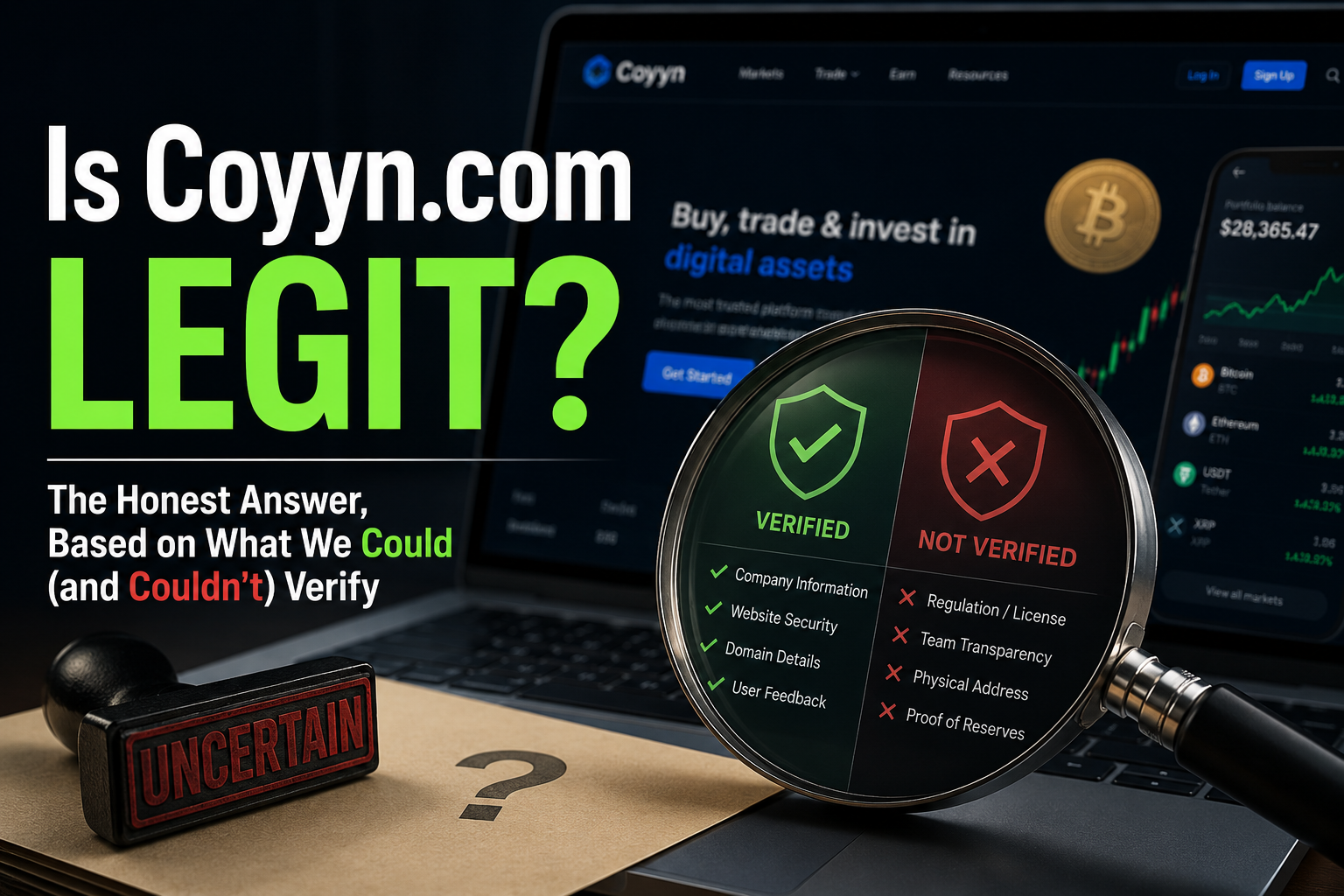
Coyyn.com is not confirmed to be an outright scam, but it fails nearly every transparency test a legitimate financial platform should pass. There is no verifiable business license, no named leadership team, no regulatory registration, and no published policy on refunds or withdrawals. If you’re considering depositing money, trading, or providing personal information through this site, you should know exactly what’s missing before you do.
This article lays out precisely what we found, what we couldn’t find, and why that gap matters.
What Coyyn.com Claims to Be
Coyyn.com describes itself as a digital financial platform facilitating online trading, investment tracking, and digital asset management, targeting entrepreneurs and small businesses looking for an easy entry into fintech-style trading. The site’s content spans an unusually wide range of financial topics: digital banking, the gig economy, private equity, cryptocurrency, and even rare coins — covering complex ideas in accessible terms for readers who want a faster learning curve.
The advertised feature set includes multi-asset trading and account management tools, quick web-based registration, and integration with both cryptocurrency and fiat transactions.
That’s a lot of ground for one platform to credibly cover — and that breadth is itself worth noting. Established financial platforms typically specialize (a crypto exchange, a stock broker, a banking app) precisely because each of those areas carries distinct regulatory requirements. A single site claiming competence across banking, trading, private equity, and rare coin investment, without specifying which licenses cover which activity, is unusual.
Red Flag #1: No Verifiable Licensing or Regulatory Registration
This is the most serious gap. There is no verified licensing information or disclosure about financial oversight for Coyyn.com — which is critical in any trading or investment environment.
Any platform that lets you deposit money, trade assets, or manage investments is, in virtually every jurisdiction, required to register with a financial regulator. In the US, that could mean registration with the SEC, FINRA, or state-level money transmitter licenses, depending on what the platform actually does. In the UK, it would mean FCA authorization. Legitimate platforms display this information prominently, usually in the footer or a dedicated “Legal” or “Regulation” page, because it’s both a legal requirement and a trust signal they want you to see.
What to check yourself: Search the platform name on your country’s financial regulator database (SEC EDGAR and FINRA BrokerCheck in the US; the FCA register in the UK). If a financial platform doesn’t appear and doesn’t clearly state why, that’s disqualifying for any meaningful use of real money.
Red Flag #2: No Identifiable Leadership or Company Information
A site investigation found no verified business address or licenses, minimal team disclosure, and inconsistent customer service responses associated with Coyyn.com.
Legitimate fintech companies — even small startups — typically name their founders, post an actual office address, and maintain a responsive support channel. This isn’t a high bar; it’s the baseline. The absence of named leadership doesn’t automatically prove bad intent, but it removes your ability to do the most basic due diligence: who is actually responsible for my money if something goes wrongRed Flag #3: No Published Refund or Withdrawal Policy
There’s no clear refund or withdrawal policy published publicly for Coyyn.com. This is one of the most practically important red flags for anyone considering depositing funds.
Before you put money into any platform, you should be able to answer: How do I get my money out? How long does a withdrawal take? What happens if I want to close my account? If a platform doesn’t answer these questions clearly before you sign up, you are trusting that the answer will be acceptable after you’ve already deposited funds — which is precisely the position scam operations want you in.
Red Flag #4: Unclear Business Model
According to available user reports, the platform works roughly like this: users register an account, deposit funds for trading or investment tracking, and platform returns are claimed to depend on market trends and internal algorithms. Yet the business model lacks clarity beyond that description.
“Returns depend on internal algorithms” is a vague claim that’s impossible to verify or audit from outside. Legitimate trading platforms typically either (a) give you direct control over your own trades on real markets, with transparent fee structures, or (b) clearly disclose the methodology, risk profile, and historical performance of any managed product. A black-box algorithm with no audit trail and no regulatory oversight is a structure that’s difficult to distinguish from a platform that simply controls the numbers you see.
Red Flag #5: A Web of Similar Domains With Mixed Trust Signals
This is something most reviews of Coyyn don’t dig into, and it’s worth knowing.
Domain trust-checking tools rate the core coyyn.com domain as medium-to-low risk — not flagged outright, but not clean either. However, related domains in the same naming family tell a more concerning story: coyyn.site has been flagged as a likely scam, with multiple other low-trust websites found hosted on the same server — a known pattern, since online scammers have a tendency to set up multiple malicious websites on one server, sometimes more than hundreds.
This doesn’t automatically mean coyyn.com itself is part of that network. Domain squatting and copycat scam sites mimicking a more “legitimate-looking” original domain are extremely common. But it does mean that the broader “Coyyn” name is actively being used across multiple sites with inconsistent trust profiles — which makes it harder for an everyday searcher to know which version of the brand, if any, they can trust.
What to check yourself: Make sure you’re on the exact domain you intend to be on. Bookmark it rather than searching each time, and be suspicious of any “Coyyn” variant domain that asks for payment or login credentials.
Red Flag #6: Content That Reads Like It Was Built for Search Engines, Not Trust
One detail that’s easy to miss: multiple independent reviewers examining Coyyn.com’s own content have noted that its articles read as AI-generated content spanning finance, banking, crypto, and rare coins — an unusually broad content strategy for a single platform.
This matters because it suggests the site’s primary content operation may be oriented around capturing search traffic across many lucrative financial keywords, rather than building deep, specialized expertise in any one of them. That’s not proof of fraud — plenty of legitimate content marketing uses AI assistance — but combined with the licensing and leadership gaps above, it fits a pattern more consistent with a traffic-and-conversion funnel than an established financial institution explaining its actual regulated services.
What We Could NOT Find (and What Would Change Our Assessment)
To be fair to Coyyn.com, here’s what we explicitly could not confirm as true or false:
- We found no confirmed evidence of stolen funds, non-payment, or direct fraud complaints tied specifically to Coyyn.com (as opposed to similarly-named domains)
- We found no confirmed evidence that the platform is a deliberate scam, as opposed to an under-documented or poorly run legitimate startup
- A valid SSL certificate was found on the core domain, which at minimum means data submitted is encrypted in transit — though this is a low bar that any site, legitimate or not, can clear
If Coyyn.com wanted to resolve these concerns, the fix is straightforward and entirely within the platform’s control: publish verifiable licensing details, name the leadership team with checkable professional backgrounds, publish a clear withdrawal and refund policy, and submit to a third-party financial audit. Until that happens, the absence of this information is the most important fact a prospective user needs to know.
How to Verify Any Financial Platform Yourself (Not Just Coyyn)
Whether or not you proceed with Coyyn specifically, here’s the checklist worth running on any platform asking you to deposit money:
1. Search the regulator, not just the company. Check SEC EDGAR, FINRA BrokerCheck, or your country’s equivalent financial authority database directly — don’t rely on claims made on the company’s own site.
2. Look for a real, checkable address. Search the address on Google Maps. Does it correspond to an actual office, or a residential address, a virtual mailbox service, or nothing at all?
3. Name-search the founders. Legitimate fintech founders typically have a LinkedIn history, prior professional roles, and a public track record that predates the company.
4. Read the withdrawal policy before you deposit anything. If you can’t find one, that’s your answer.
5. Check independent, third-party trust scoring tools like ScamAdviser — but treat them as one input, not a final verdict. Algorithmic trust scores can miss new scams and occasionally flag legitimate new businesses unfairly.
6. Search “[platform name] complaint” and “[platform name] withdrawal problem” specifically — generic review searches often surface promotional content rather than user complaints.
7. Never deposit more than you’re prepared to lose entirely, especially with any platform that doesn’t clear the checks above.
If You Want a Regulated Alternative
If what drew you to Coyyn.com was an interest in digital trading, crypto, or investment tracking, regulated platforms with verifiable licensing and established track records include options like Coinbase (crypto, regulated in multiple jurisdictions), eToro (multi-asset trading, regulated by multiple financial authorities), and Interactive Brokers (broad market access, longstanding regulatory history). This isn’t an endorsement of any specific platform’s suitability for your needs, but each of these at minimum clears the basic transparency bar that Coyyn.com currently does not.
Frequently Asked Questions
Is Coyyn.com a scam? We cannot confirm this definitively either way. What we can confirm is that it lacks the licensing, leadership transparency, and policy disclosures that legitimate financial platforms typically provide. Treat that absence as a serious warning sign, not a minor inconvenience.
Is coyyn.com safe to give my personal information to? Given the lack of verifiable business registration and unclear data handling policies, we’d recommend against submitting sensitive personal or financial information until the platform publishes clearer documentation.
Why does Coyyn.com rank so well on Google if it’s this unclear? Broad content coverage across many financial search terms, combined with relatively low keyword competition for a newer brand name, can produce strong search visibility independent of the platform’s underlying legitimacy or regulatory status. Search ranking is not a trust signal.
I already deposited money with Coyyn.com — what should I do? Document everything (screenshots of your account, transaction records, any communication). Attempt a withdrawal and record the outcome. If you encounter problems, contact your bank or card provider about a chargeback, and consider reporting to your country’s financial fraud reporting body (in the US, the FTC at reportfraud.ftc.gov; in the UK, Action Fraud).
Are all “Coyyn” branded sites the same? No — and this is important. Coyyn.com, coyyn.site, and coyyn.com.in appear to be separate domains with different trust profiles. Don’t assume that because one is more established, all variants share the same legitimacy.
Bottom Line
Coyyn.com is not confirmed as fraudulent, but it is unverified — and in finance, unverified should be treated the same as untrusted until proven otherwise. The absence of licensing information, named leadership, and a clear withdrawal policy aren’t small oversights; they’re the exact disclosures that exist specifically to protect users, and their absence shifts all the risk onto you.
If you’re researching Coyyn.com because you’re considering using it, the most useful thing this article can tell you is: do not deposit funds until the platform can answer the questions above in writing, on its own site, with information you can independently verify.