


Islamic Wishes for a Newly Married Couple: The Authentic Du’a, Meanings, and 100+ Heartfelt Messages
The Authentic Sunnah Du’a for Newlyweds Before any list of messages, it’s worth starting with what actually carries the
The Authentic Sunnah Du’a for Newlyweds
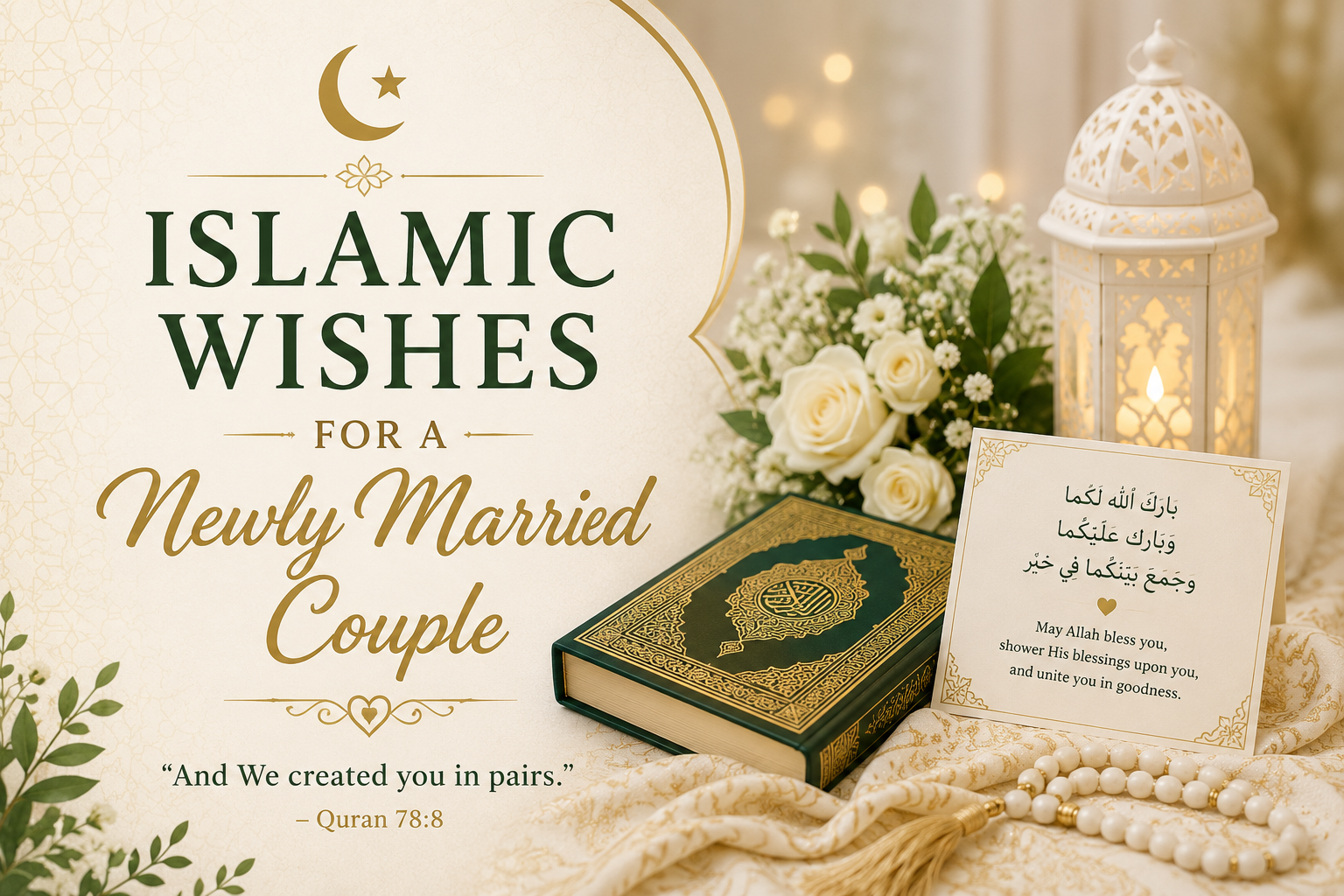
Before any list of messages, it’s worth starting with what actually carries the most weight: the specific du’a the Prophet Muhammad ﷺ himself used when congratulating a newly married couple.
Abu Hurairah (RA) narrated that when supplicating for the newlywed, the Prophet ﷺ would say:
بَارَكَ اللَّهُ لَكَ وَبَارَكَ عَلَيْكَ وَجَمَعَ بَيْنَكُمَا فِي خَيْرٍ
Transliteration: Baarakallaahu laka, wa baaraka ‘alayka, wa jama’a baynakumaa fee khayr
Meaning: “May Allah bless you and send blessings upon you, and bring goodness between you.”
This du’a is recorded in Jami’ at-Tirmidhi (Hadith 1091), graded hasan sahih (good and authentic) by the scholars of hadith. It is the single most recommended and authentic phrase to offer a newly married Muslim couple, and it’s the foundation that everything else in this guide builds on.
A note on grammar: The version above uses the dual/masculine singular Arabic form. When addressing a couple together, many people use the dual form: Baarakallaahu lakumaa, wa baaraka ‘alaykumaa, wa jama’a baynakumaa fee khayr — “May Allah bless you both, and send blessings upon you both, and bring goodness between you.” Both forms are used and accepted; the dual form is simply more explicitly addressed to two people at once.
Why This Particular Du’a Matters More Than Generic Wishes
Many wedding wish lists online mix generic “congratulations” messages with religious phrases, without clarifying which carries the weight of authentic Prophetic tradition (Sunnah) versus which is simply a nice cultural sentiment. That distinction matters to many Muslims, and it’s worth being clear about it here.
Saying this specific du’a isn’t just a nice phrase — it’s following the example of the Prophet ﷺ himself, which carries spiritual reward (ajr) beyond the sentiment of the words alone. For that reason, even if you choose to write a longer, more personal message, including this exact phrase — in Arabic, transliteration, or translation — connects your wishes to authentic Islamic practice.
What NOT to Say: A Note on Avoiding Common Cultural Additions
It’s worth being transparent about something most articles on this topic skip: many commonly circulated “Islamic” wedding phrases are cultural additions rather than directly sourced from hadith or Quran. Phrases like elaborate poetic blessings, numerology-based phrases, or wishes invoking specific saints or intermediaries are cultural practices in some Muslim communities, not textually sourced Islamic teachings.
This doesn’t make heartfelt, warm wishes inappropriate — sincerity and good intentions (niyyah) matter, and Islam doesn’t require every wedding message to be a direct hadith quotation. But if your goal is specifically “Islamic” wishes rooted in authentic teaching, it’s worth knowing the difference between the Sunnah du’a above and the broader category of warm-but-generic Islamic-flavored messages below.
Quick Navigation
- The Authentic Sunnah Du’a (above)
- Formal Islamic Wedding Wishes (English)
- Short Islamic Wedding Wishes for Cards and Texts
- Islamic Wedding Wishes in Arabic with Transliteration
- Wishes Specifically for a Sister or Brother
- Wishes Specifically for a Friend
- Quranic Verses Appropriate for Wedding Wishes
- How to Write Your Own Islamic Wedding Wish
- FAQ
Formal Islamic Wedding Wishes (English)
These are suited for wedding cards, formal messages, or speaking directly to the couple at the celebration.
“Barakallahu lakuma wa baraka ‘alaykuma wa jama’a baynakuma fi khayr. May Allah bless this union and fill your home with peace, patience, and mercy.”
“May Allah (SWT) make this marriage a means of comfort, tranquility, and closeness to Him for both of you. Congratulations on your nikah.”
“On this blessed day, I pray that Allah grants you a marriage built on faith, kindness, and mutual respect — a partnership that draws you both closer to Jannah.”
“May your marriage be a reflection of the love and mercy Allah describes in the Quran — a source of peace for one another, in this life and the next.”
“Congratulations on your nikah. May Allah make your marriage easy, your hearts united, and your home filled with barakah.”
“May Allah grant you both a marriage strengthened by patience in hardship and gratitude in ease — and may He bless your home with righteous children, if it is His will.”
“As you begin this new chapter together, may Allah’s guidance light your path, His mercy soften your hearts toward one another, and His blessings multiply in your home.”
Short Islamic Wedding Wishes for Cards and Texts
For when you need something brief but meaningful — perfect for a card, a text message, or a social media comment.
“Barakallahu lakuma! Wishing you both a blessed and beautiful marriage.”
“Mabrook on your nikah! May Allah bless your union always.”
“May Allah unite your hearts in love and faith. Congratulations!”
“Wishing you a marriage filled with sakinah (tranquility), mawaddah (love), and rahmah (mercy).”
“May your marriage be blessed in this world and the next. Mabrook!”
“Congratulations on your nikah — may it be the beginning of a beautiful, faith-filled journey together.”
“May Allah keep you both united in goodness, always.”
“Barakallahu feekuma — may Allah bless you both abundantly.”
Islamic Wedding Wishes in Arabic (With Transliteration and Meaning)
For those who want to offer wishes in Arabic, with English support for those less familiar with the language.
مبروك (Mabrook) — “Congratulations” / “Blessed”
بارك الله لكما (Barakallahu lakuma) — “May Allah bless you both”
بارك الله لكما وبارك عليكما وجمع بينكما في خير (Barakallahu lakuma wa baraka ‘alaykuma wa jama’a baynakuma fi khayr) — The full authentic Sunnah du’a: “May Allah bless you both, shower blessings upon you both, and bring you together in goodness”
جعل الله بيتكما عامرا بالسكينة والمودة والرحمة (Ja’alallahu baytakuma ‘amiran bis-sakinati wal mawaddati war rahmah) — “May Allah fill your home with tranquility, love, and mercy”
This last phrase draws directly on the language of Quran 30:21, which describes the purpose of marriage in these very terms — making it a meaningful phrase to include precisely because it echoes scripture rather than being a purely cultural addition.
Islamic Wedding Wishes for a Sister
These carry the warmth appropriate for a sibling relationship while keeping the Islamic foundation.
“My dear sister, may Allah bless your marriage abundantly. May He grant you a husband who is a source of comfort, faith, and happiness for you. Barakallahu laki.”
“Watching you begin this new chapter fills my heart with joy. May Allah make your marriage a means of peace for your soul and a path closer to Him. I love you and I’m praying for your happiness always.”
“May Allah grant you the marriage He describes in the Quran — a source of tranquility, love, and mercy. You deserve every bit of happiness, my dear sister.”
Islamic Wedding Wishes for a Friend
Warm and personal while still rooted in Islamic sentiment.
“Congratulations, my dear friend! May Allah bless your marriage with everlasting love, patience, and faith. Barakallahu lakuma!”
“Seeing you start this beautiful journey means so much to me. May your home always be filled with sakinah, and may Allah make this the easiest, most blessed chapter of your life.”
“You deserve every happiness this new chapter brings. May Allah unite your hearts in goodness and keep you both close to Him, always.”
Quranic Verses Appropriate for Wedding Wishes
For those who want to include scripture directly, this verse is the most commonly referenced in the context of marriage, and appropriately so — it describes the very purpose of marital union in Islam:
“And of His signs is that He created for you from yourselves mates that you may find tranquility in them; and He placed between you affection and mercy. Indeed in that are signs for a people who give thought.” (Quran 30:21)
Including a reference to this verse — either quoted directly or referenced by name (“a marriage built on the sakinah, mawaddah, and rahmah described in Surah Ar-Rum”) — is one of the most authentically grounded ways to frame a wedding wish, since it draws on the Quran’s own description of what marriage is meant to be.
How to Write Your Own Islamic Wedding Wish
If none of the messages above feel quite right, here’s a simple structure for writing something personal that still carries authentic Islamic grounding:
1. Open with the Sunnah du’a (in Arabic, transliteration, or translation) — this anchors your message in authentic tradition before anything else.
2. Add a personal note specific to the couple — a shared memory, a quality you admire in them, or what their union means to you personally.
3. Close with a specific dua for their future — peace, patience, righteous children, closeness to Allah, or strength through life’s trials. Be specific rather than generic; a wish tailored to what you know about the couple feels more sincere than a copy-paste line.
Example combining all three: “Barakallahu lakuma wa baraka ‘alaykuma wa jama’a baynakuma fi khayr. From the moment I met you both, I knew this was a friendship — and now a marriage — built on something real. May Allah make your home a place of sakinah, may He bless you with patience through every trial, and may He reward your love for each other in this life and the next. Mabrook, always.”
Frequently Asked Questions
What is the most authentic Islamic wedding wish? The du’a recorded in Jami’ at-Tirmidhi (Hadith 1091): “Barakallahu laka wa baraka ‘alayka wa jama’a baynakuma fi khayr” — “May Allah bless you and send blessings upon you, and bring goodness between you.” This is the specific phrase the Prophet ﷺ used when congratulating newlyweds, graded hasan sahih by hadith scholars.
What does “Barakallahu lakuma” mean? “May Allah bless you both.” It’s a shortened, commonly used form of the fuller Sunnah du’a, appropriate for both spoken and written wedding wishes.
Is “Mabrook” an Islamic phrase or just cultural? “Mabrook” (مبروك) simply means “congratulations” or “blessed” in Arabic and is widely used across Muslim cultures for any joyful occasion, not specifically derived from hadith. It’s appropriate and commonly used, but it isn’t the same as the specific Sunnah du’a above — many people use both together.
Can I wish a Muslim couple congratulations if I’m not Muslim? Yes. A sincere, warm congratulations is always appropriate and appreciated regardless of your own faith background. If you’d like to include an Islamic phrase as a sign of respect for their faith, “Mabrook” or “Congratulations, may you be blessed with a happy marriage” are simple, respectful options that don’t require deep familiarity with Arabic or Islamic terminology.
What’s the difference between du’a and just a wish or greeting? A du’a (دعاء) is specifically a supplication or prayer addressed to Allah on someone’s behalf — it’s a request for God’s blessing, not just a sentiment expressed to the couple directly. The Sunnah du’a above is technically a prayer, even though it’s spoken to the couple in the form of a wish.
Is it appropriate to send these wishes by text or social media? Yes — the format (spoken, written card, text message, social media comment) doesn’t change the appropriateness or sincerity of the wish itself. Many people now send the Sunnah du’a via text or as a wedding card message, and it remains equally meaningful.
The Bottom Line
The single most important thing to take from this guide is the authentic Sunnah du’a itself — Barakallahu laka wa baraka ‘alayka wa jama’a baynakuma fi khayr — sourced directly from Jami’ at-Tirmidhi and graded authentic by hadith scholars. Whether you use it alone, in Arabic or translation, or build a longer personal message around it, including this specific phrase connects your congratulations to the Prophetic tradition itself, which is the most meaningful gift you can offer a newly married Muslim couple beyond your own sincere good wishes.
Sources: Jami’ at-Tirmidhi, Hadith 1091 (sunnah.com); Sunan Abu Dawud and Sunan Ibn Majah (parallel narrations of the same du’a); Quran 30:21 (Surah Ar-Rum). All hadith and Quranic citations have been verified against primary collections rather than secondary paraphrase.
A note on accuracy: Religious content carries particular responsibility for accuracy. If any phrasing, transliteration, or attribution in this article should be corrected, please reach out — we are committed to keeping this guide aligned with authentic sourcing.