

Kevin Keegan: The Life, Legacy and Career of King Kev
On 20 July 2026, Joseph Kevin Keegan died at the age of 75 after a battle with cancer that
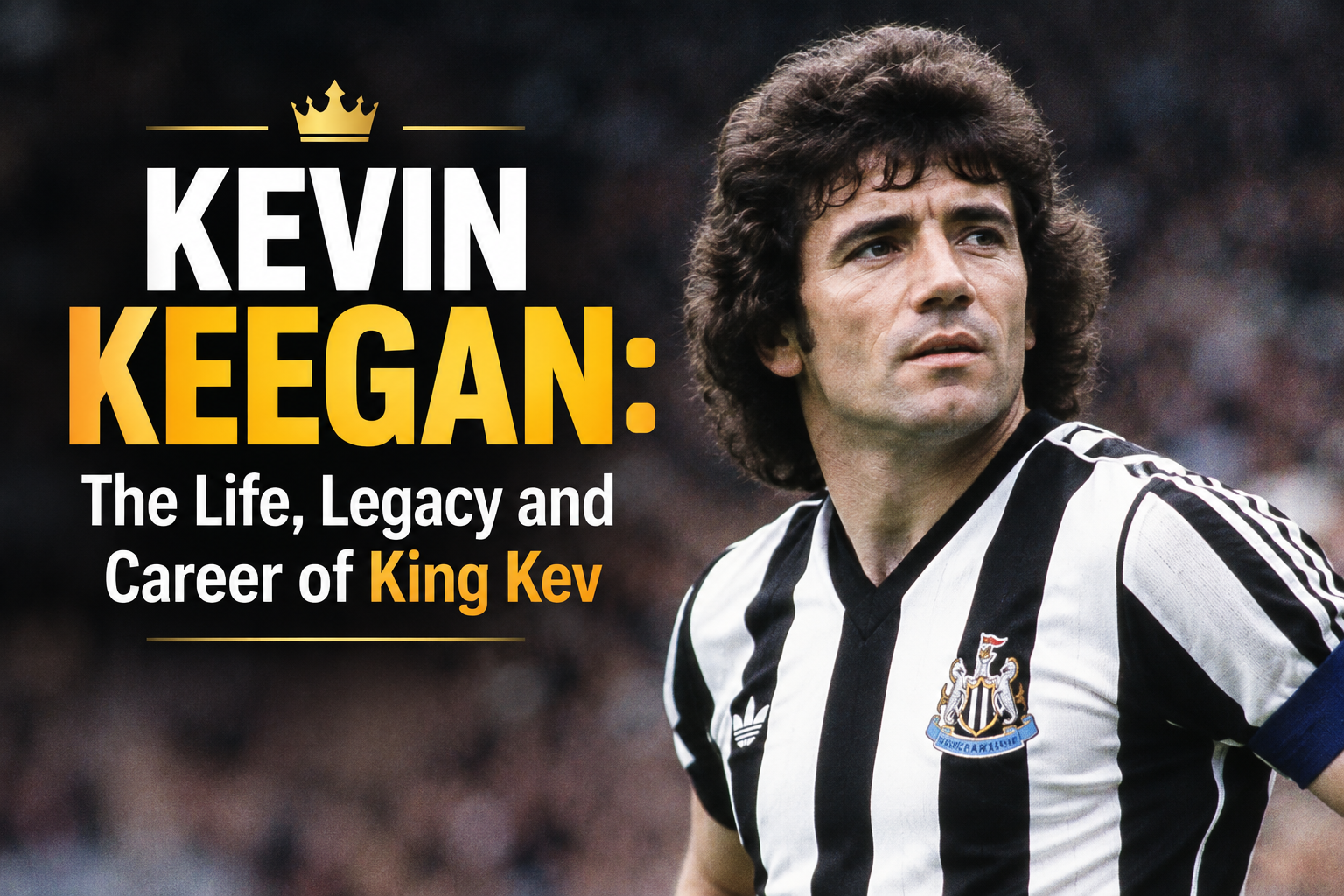
On 20 July 2026, Joseph Kevin Keegan died at the age of 75 after a battle with cancer that his family had first disclosed in January of that year. He was surrounded by his wife and daughters in his final moments.
Newcastle United’s statement called him “the beating heart of Newcastle United for generations of supporters.” His family described him as “a much loved husband, father and grandfather.” What English football called him, collectively, was King Kev — a title earned twice over, first as a player and then as a manager, in a career defined by the same quality that ran through everything he did: an inability to be anything other than exactly himself.
Quick Answer
Kevin Keegan was an English footballer born on 14 February 1951 in Armthorpe, near Doncaster. He played for Scunthorpe United, Liverpool, Hamburger SV, Southampton, and Newcastle United, scoring 204 goals in 592 club appearances. He won two consecutive Ballon d’Or awards (1978 and 1979), three Football League titles and the 1977 European Cup with Liverpool, and earned 63 England caps scoring 21 goals. He managed Newcastle United, Fulham, England, and Manchester City. He died on 20 July 2026 at the age of 75 following a cancer diagnosis.
Early Life: From Armthorpe to Anfield
Kevin Keegan was born on St Valentine’s Day 1951 in Armthorpe, a village near Doncaster in South Yorkshire. His father Joe worked down the pit. The family was not wealthy, and football was what Keegan had — a natural gift combined with a work ethic that bordered on obsessive even as a teenager.
He had a trial with Coventry City that came to nothing. He signed for Scunthorpe United in December 1967 as an apprentice, turning professional a year later. He made 124 appearances for Scunthorpe, scoring 18 goals — productive for a young player at a lower-league club, but not the numbers that made you think you were watching a future European Footballer of the Year.
Bill Shankly saw something different. In May 1971, Liverpool paid £33,000 — a modest fee even then — to bring Keegan to Anfield. It was one of the most consequential pieces of transfer business in English football history.
Liverpool: Three Titles and a European Cup
At Liverpool, Keegan became the player his talent had always suggested he could be. Quick, direct, tireless in his pressing before pressing had a name, and intelligent in his movement — he was the archetype of the modern forward decades before the position was properly theorised.
Between 1971 and 1977, he made 230 appearances for Liverpool, scored 68 goals, and collected three Football League championships and the 1977 European Cup — won against Borussia Mönchengladbach in Rome, with Keegan directly involved in both the first goal and the penalty that led to the second. He was magnificent that night, and he knew it was his last game for the club. He had already agreed to leave.
The move to Germany was his own idea, driven by a desire to test himself against a different football culture. Liverpool sold him to Hamburger SV for £500,000 — a British transfer record at the time — and Keegan went off to reinvent himself on the continent.
Hamburg: Two Ballon d’Or Awards Back to Back
What happened in Germany was extraordinary. Keegan adapted completely to the Bundesliga — technically more demanding, more physically robust, contested against the best players in Europe every week.
In 1978, he won the Ballon d’Or — the award for European Footballer of the Year. In 1979, he won it again. Back-to-back Ballon d’Or awards for a British player. No British player has matched it in the nearly five decades since.
He made 90 appearances for Hamburger SV, scored 32 goals, and won the Bundesliga title in the 1978–79 season. Hamburg were also Bundesliga runners-up twice during his time at the club, and European Cup finalists in 1980 — losing narrowly to Nottingham Forest.
He was not simply good in Germany. He was the best in Europe.
Southampton, Newcastle, and Retirement
Keegan returned to England in 1980, joining Southampton for £400,000. He spent two years there — productive, but the end of his peak. In 1982, he made a decision that would define his relationship with English football for the rest of his life: he signed for Newcastle United for £100,000.
Newcastle were in the Second Division. The city had not seen a player of Keegan’s calibre in years, possibly ever. The impact was immediate and visceral. He made 78 appearances, scored 48 goals, and St James’ Park was transformed from a ground of diminishing expectations into something resembling a cathedral of football belief.
He retired in May 1984. He was 33 years old, and he had done everything a footballer of his era could do.
England: 63 Caps, 21 Goals, the Captain’s Armband
Across his playing career, Keegan won 63 England caps and scored 21 goals — a respectable record for an era when England’s top players were competing with some of the best European opposition the tournament structure of the time could provide.
He captained the national team, led them at major tournaments, and was the most recognisable English footballer of the late 1970s on the global stage. The perm. The energy. The smile. Kevin Keegan was English football’s first genuine pop star in an era when that combination of fame and talent was genuinely new.
Newcastle United Manager: The Entertainers
Eight years after retiring as a player, Keegan returned to football as Newcastle’s manager in February 1992. The club was struggling in the old Second Division. He had no managerial experience. Almost nobody expected it to work.
It worked beyond anyone’s expectations.
Newcastle won promotion to the Premier League as First Division champions in 1993. They then built what became known as the Entertainers — a side of attacking football so committed, so joyful, so wonderfully impractical in its ambition, that it captured the imagination of supporters far beyond Tyneside.
Peter Beardsley. Les Ferdinand. David Ginola. Tino Asprilla. Andy Cole. The 1995–96 season, during which Newcastle led the Premier League by twelve points in January before finishing four points behind Manchester United, has been discussed, analysed, and mourned continuously for thirty years.
And then came the interview.
On 29 April 1996, after a win over Leeds United, Kevin Keegan was asked to respond to Sir Alex Ferguson’s suggestion that other clubs would not try hard enough against Manchester United. He responded, live on Sky Sports, in a way that had nothing to do with media management and everything to do with who he was.
“I will love it if we beat them. Love it.”
The delivery. The voice breaking with genuine emotion. The absolute inability to be strategic when passion was available instead. That forty-five seconds has been replayed thousands of times. It is not a moment of weakness. It is the most Kevin Keegan thing Kevin Keegan ever did — and Kevin Keegan did a great many Kevin Keegan things.
He resigned as Newcastle manager in January 1997, three months after the title race was lost.
Fulham, England, Manchester City
Keegan managed Fulham from 1997 to 1999, guiding them to the Second Division title — the beginning of the club’s ascent that would eventually take them to the Premier League under subsequent management. He was appointed England manager in February 1999, succeeding Glenn Hoddle.
His tenure ended on 7 October 2000, the night after a 1–0 defeat against Germany in the last game played at the old Wembley stadium, a World Cup qualifier that ended England’s campaign. He resigned in the Wembley toilets immediately after the match, telling his staff he did not have what was needed to take the team further. It was — characteristically — an honest assessment.
He managed Manchester City between 2001 and 2005, taking them to their highest Premier League finish of the time. He made a brief and turbulent return to Newcastle in 2008 before departing after eight months in a dispute over transfer policy.
The Illness and Final Years
In January 2026, Keegan’s family disclosed that he had been admitted to hospital with abdominal symptoms and had been diagnosed with cancer. The statement was brief, private, and dignified — consistent with the way those around him had always protected what mattered most to him: the family, not the fame.
In June 2026, his family announced the cancer had progressed to stage four. On 20 July 2026, Kevin Keegan died at the age of 75, surrounded by his wife Jean and his daughters.
His family’s statement said: “Kevin, a double Ballon d’Or winner, was a much loved husband, father and grandfather. The family would like to thank Kevin’s incredible medical team for all their support.”
What He Left Behind
No British player has won back-to-back Ballon d’Or awards in the fifty years since Keegan did it. St James’ Park still measures its ambitions against the Entertainers side he assembled and almost took to the title. The “I will love it” clip has outlasted almost every piece of football commentary from its era.
He built a reputation twice — as a player and as a manager — and both times he did it the same way: with complete commitment, absolute honesty about what he felt, and an infectious belief that football was worth caring about deeply.
That is not a small thing to leave behind. In a sport increasingly defined by managed distance and calibrated messaging, Kevin Keegan spent his entire career telling everyone exactly what he thought and felt.
He loved it. He will be genuinely missed.
You might also like:
- Gordon Ramsay Net Worth: How the Chef Built a $220M Fortune
- Browse all Celebrity on Vivid Magazine
- Browse all Entertainment on Vivid Magazine
Frequently Asked Questions
When did Kevin Keegan die? Kevin Keegan died on 20 July 2026 at the age of 75. His family had disclosed his cancer diagnosis in January 2026 and confirmed it had progressed to stage four in June 2026. He was surrounded by his wife Jean and his daughters in his final moments.
What did Kevin Keegan win as a player? Three Football League championships with Liverpool, the 1977 European Cup with Liverpool, the 1978–79 Bundesliga title with Hamburger SV, and two consecutive Ballon d’Or awards (1978 and 1979) — becoming European Footballer of the Year back-to-back. He won 63 England caps and scored 21 goals.
Why was Kevin Keegan called King Kev? The nickname reflects his status at Newcastle United both as a player (1982–1984) and as a manager (1992–1997). He joined as a player when the club were in the Second Division and immediately transformed their fortunes. As manager, he built the Entertainers — one of the most beloved English club sides of the 1990s.
What is Kevin Keegan’s most famous quote? “I will love it if we beat them. Love it” — delivered live on Sky Sports on 29 April 1996 in response to Alex Ferguson’s suggestion that other clubs would ease off against Manchester United. The moment has been replayed continuously for thirty years and remains one of the most emotionally raw clips in English football broadcasting history.
Who did Kevin Keegan manage? Newcastle United (1992–1997 and briefly 2008), Fulham (1997–1999), England national team (1999–2000), and Manchester City (2001–2005).