




How to Clean a Dishwasher (Filter, Inside, and With Vinegar) — The Complete Guide
Your dishwasher cleans everything you put into it — but nobody cleans the dishwasher itself. The result is a
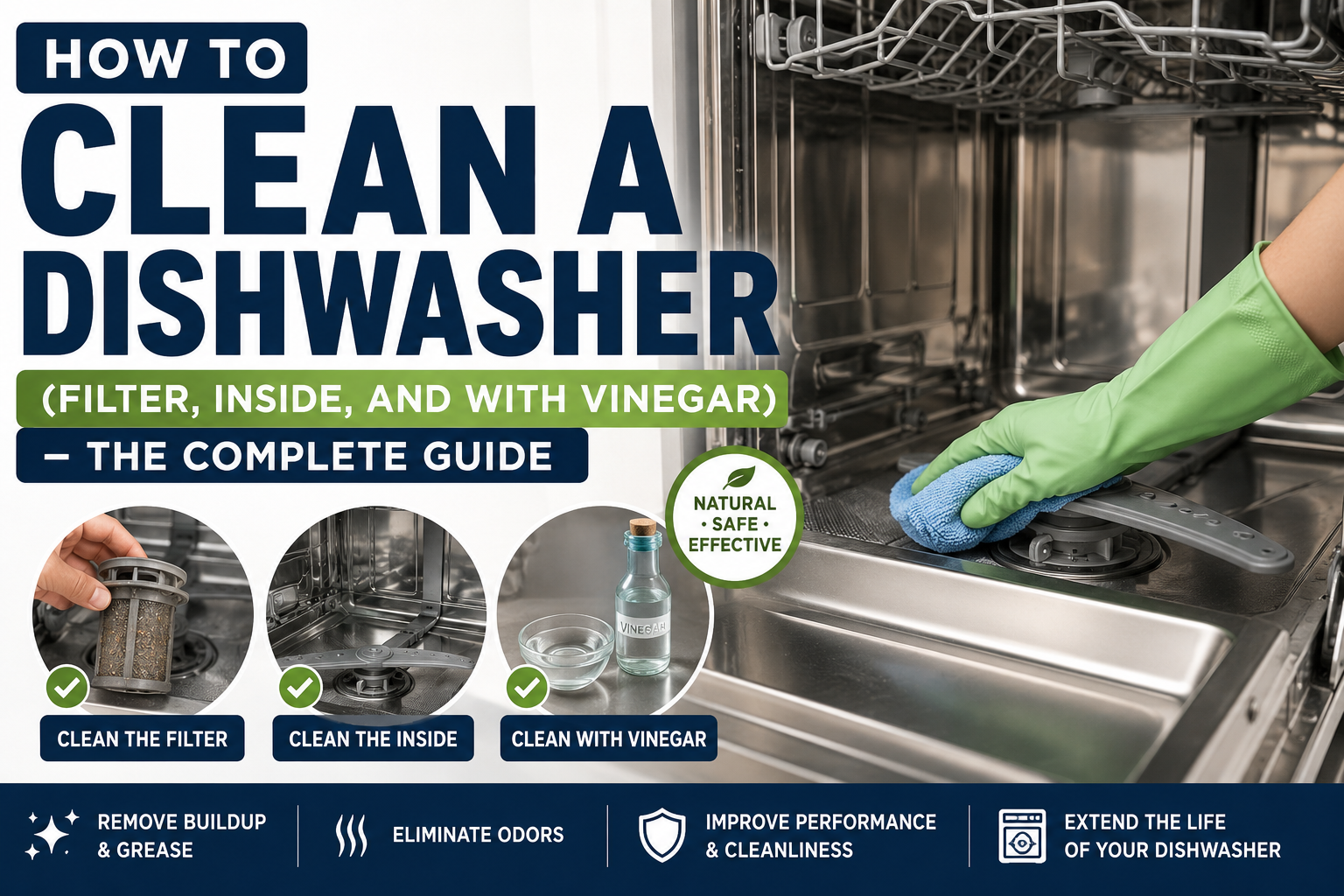
Your dishwasher cleans everything you put into it — but nobody cleans the dishwasher itself. The result is a slow, invisible decline: dishes come out cloudy, a musty smell greets you every time you open the door, and eventually the machine just doesn’t clean the way it used to.
The fix is simple. A 15-minute cleaning routine, done monthly, will make your dishwasher work like new, eliminate odors, and add years to the appliance’s life. This guide covers everything: how to clean the dishwasher filter (the most important step almost everyone skips), how to deep clean the inside with vinegar and baking soda, how to clean the spray arms, door gasket, and drain, plus a full maintenance schedule to keep it running at peak performance.
Why Your Dishwasher Needs to Be Cleaned
Over time, every dishwasher accumulates a combination of food particles, grease, soap scum, and hard water mineral deposits. This buildup doesn’t stay safely contained — it recirculates. It coats the interior walls, clogs the spray arm holes, and accumulates in the filter until water can’t flow properly.
The effects are practical and immediate:
- Dishes come out with a white film, cloudiness, or gritty residue — mineral deposits and food particles recirculating through a clogged filter
- A sour or musty smell when you open the door — bacteria growing in trapped food debris and standing water
- Water pooling at the bottom of the tub — a clogged filter or drain restricting water flow
- Dishes that aren’t fully clean despite a full cycle — spray arms clogged or filter blocking water circulation
- Higher energy bills — a machine working harder to compensate for restricted flow
Cleaning your dishwasher once a month — and specifically cleaning the filter every one to three months — prevents all of these problems at once.
What You Need
Everything required is already in your kitchen:
- White distilled vinegar (2 cups)
- Baking soda (1 cup)
- Mild dish soap
- A soft-bristle brush or old toothbrush
- A microfiber cloth or soft sponge
- Warm water
- Optional: dishwasher cleaning tablet (Affresh, Finish, or similar)
Do not use bleach if your dishwasher has a stainless steel interior. Do not mix vinegar and bleach at any point. Do not use abrasive scrubbing pads — they scratch surfaces and damage filter mesh.
How to Clean the Dishwasher Filter
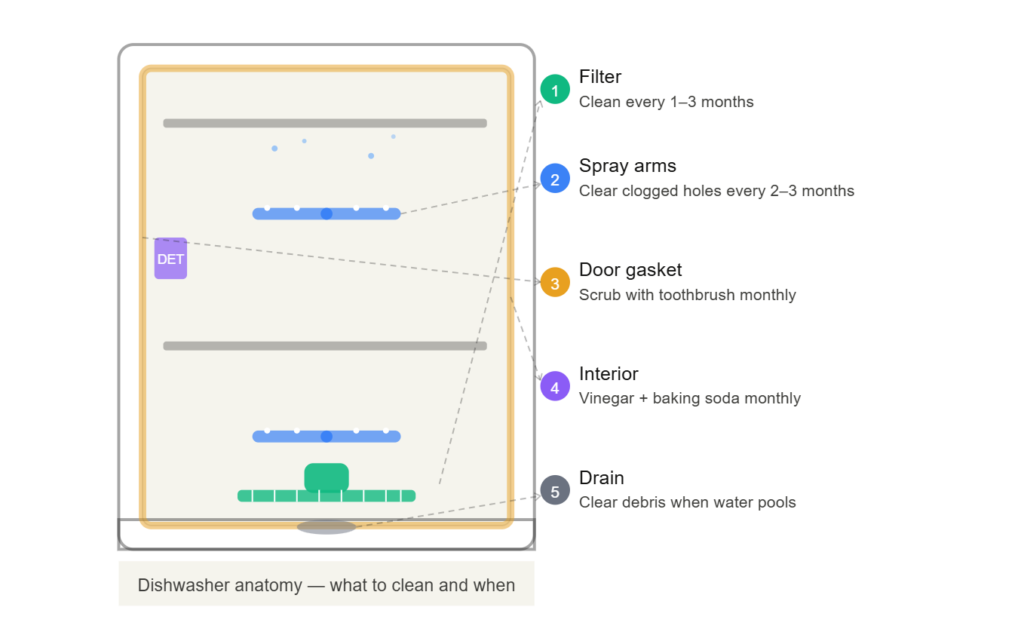
This is the single most important step, and the one most people have never done. The filter sits at the bottom of the dishwasher tub and traps food particles during every wash cycle to prevent them from recirculating onto your dishes. When it clogs — which it will, with regular use — cleaning performance drops significantly and odors follow.
Where Is the Dishwasher Filter?
The filter is located at the bottom of the dishwasher tub, beneath the lower rack. To find it, pull out the bottom dish rack completely and look at the floor of the dishwasher. It’s either in the center of the tub floor near the base of the lower spray arm, or in one of the back corners.
The filter typically looks like a short cylindrical tube surrounded by a flat mesh plate — it’s usually the only part of the tub floor that looks removable.
Two types of dishwasher filters:
Manual filters (most modern dishwashers manufactured after 2010) — a removable mesh and cylindrical assembly that requires regular hand-cleaning. Quieter than self-cleaning models, but needs attention every one to three months.
Self-cleaning filters (older models and some commercial-style dishwashers) — these use a grinder mechanism to pulverize food particles that are then washed down the drain. They’re louder but require little maintenance. If your older dishwasher is noisy during a cycle, it probably has a self-cleaning filter.
Not sure which type you have? Check your owner’s manual, or simply look at the bottom of the tub — if you can see a cylindrical mesh part that appears to twist out, it’s a manual filter.
Step-by-Step: How to Clean a Dishwasher Filter
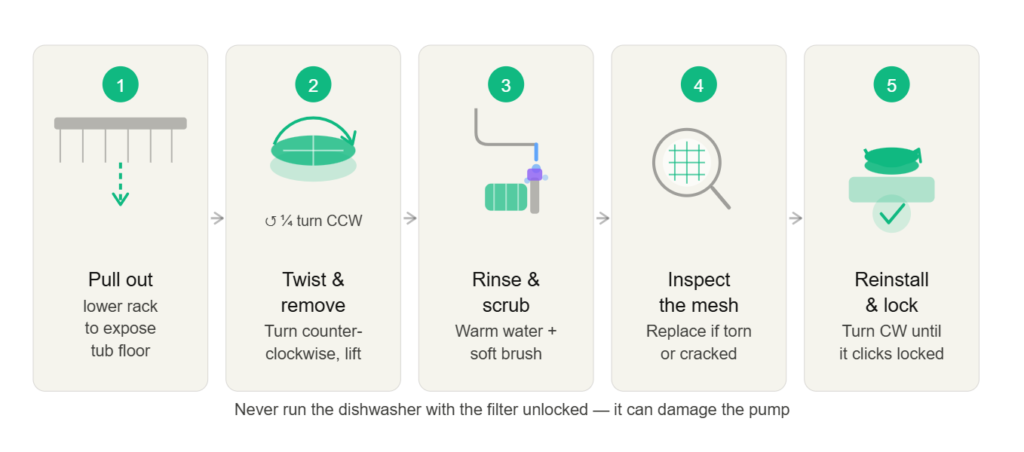
Step 1: Remove the lower dish rack Pull the bottom rack all the way out and set it aside. This gives you full access to the tub floor.
Step 2: Locate and remove the filter Most manual filters have two parts — an upper cylindrical filter and a lower flat mesh filter. Grip the cylindrical upper filter and turn it a quarter-turn counterclockwise to unlock it, then lift it straight up and out. Next, gently lift the flat lower filter slightly, then pull it forward toward you to remove it. Keep a towel handy — a small amount of water may spill.
Some models have slight variations: check your brand’s instructions if the filter doesn’t move after a quarter-turn. Never force it.
Step 3: Rinse under warm running water Hold both filter pieces under warm running water to flush out loose food particles and debris. This removes the majority of buildup in under a minute.
Step 4: Scrub with dish soap and a soft brush Apply a small amount of mild dish soap and use a soft-bristle brush or old toothbrush to gently scrub the mesh surface. Pay special attention to the fine mesh weave and the edges where grease accumulates. For stubborn calcium deposits or stuck-on grease, soak the filter in a bowl of warm water and white vinegar for 10–15 minutes before scrubbing.
Never use a wire brush, steel wool, or abrasive scouring pad. These will tear or scratch the mesh, making the filter less effective or requiring replacement.
Step 5: Rinse thoroughly Rinse both pieces completely under warm water until no soap residue remains.
Step 6: Check for damage Before reinstalling, inspect the filter mesh for any tears, holes, or cracks. A damaged filter cannot trap food particles effectively, and small debris will start circulating back onto your dishes. Replacement filters are inexpensive — search your dishwasher’s model number online or check the manufacturer’s website.
Step 7: Reinstall correctly Place the flat lower filter back in the tub first, positioning it properly under the tabs so it lies flat. Then fit the cylindrical upper filter into the round opening in the lower filter. Turn it clockwise — you should feel it drop into a locked position. If it still spins freely, it’s not seated correctly. Keep turning clockwise until it locks.
Do not run the dishwasher until both filter pieces are securely locked. An improperly installed filter can damage the pump.
How Often to Clean the Dishwasher Filter
For daily or frequent use: clean every 1–2 months. For moderate use (a few times per week): every 2–3 months. For occasional use: every 3–6 months.
Clean the filter immediately — regardless of schedule — if you notice dishes coming out with grit or film, a bad smell from inside the machine, or water pooling at the bottom of the tub after a cycle.
How to Clean a Dishwasher With Vinegar and Baking Soda
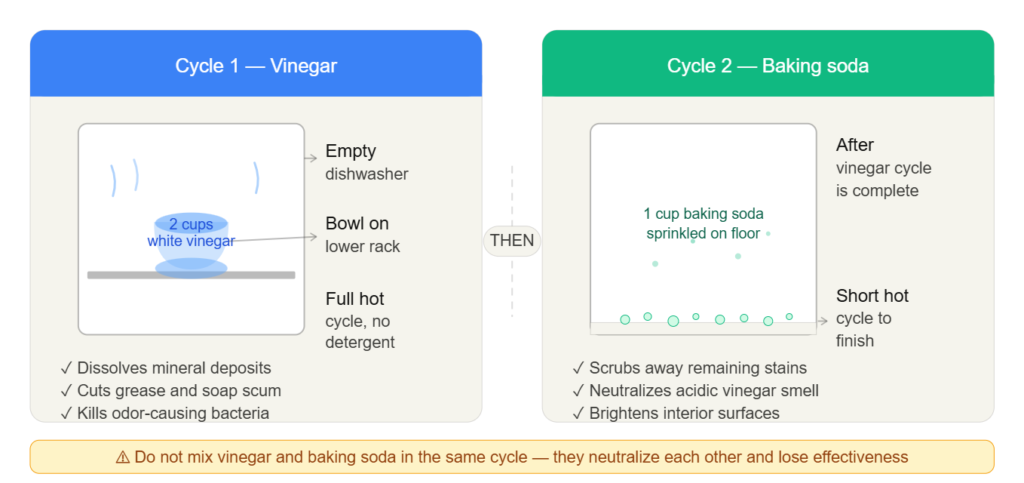
After cleaning the filter, the interior of the dishwasher needs attention. White vinegar dissolves mineral deposits, grease, and soap scum. Baking soda neutralizes odors and brightens stained surfaces. Used together in a two-step cycle, they do the job of most commercial dishwasher cleaners at a fraction of the cost.
Important note on vinegar: Vinegar is an acid. It’s effective for occasional deep cleaning, but using it too frequently can gradually deteriorate rubber door gaskets and internal seals. Use this method monthly — not after every cycle.
Do not mix vinegar and baking soda in the same wash cycle. They react and neutralize each other, reducing the effectiveness of both. Run them as two separate cycles.
Step 1: Run the Vinegar Cycle
Make sure the dishwasher is empty and the filter is clean (do Part 1 first).
Place 2 cups of white distilled vinegar in a dishwasher-safe container — a glass measuring cup or bowl works well — and set it upright on the lower rack. Do not add dishwasher detergent. Do not put the vinegar in the detergent dispenser.
Run a full normal wash cycle on the hottest temperature setting, with the heat dry option turned off. The hot water will distribute the vinegar throughout the tub, dissolving mineral deposits, cutting through grease buildup, and eliminating odor-causing bacteria.
When the cycle finishes, open the door and let it air out for a few minutes. You’ll notice the interior looks brighter and the smell has changed considerably.
Step 2: Run the Baking Soda Cycle
With the vinegar cycle complete, sprinkle 1 cup of baking soda evenly across the bottom of the dishwasher tub. Run a short, hot wash cycle. The baking soda acts as a mild abrasive, scrubbing away remaining stains and residue, and it neutralizes any remaining acidic odors from the vinegar.
When this cycle finishes, your dishwasher interior should look noticeably cleaner, and any lingering odors should be gone.
Using a Dishwasher Cleaning Tablet Instead
If you prefer a commercial cleaner over the vinegar method, dishwasher cleaning tablets (Affresh, Finish Dishwasher Cleaner, or similar) are an excellent alternative. They’re formulated specifically to remove mineral buildup, grease, and limescale from dishwasher interiors.
Clean the filter first, then follow the tablet’s directions — most are placed in the detergent tray or on the bottom rack, and you run a normal cycle without dishes. These tablets work well for households on hard water, where mineral deposits are a persistent problem.
Cleaning the Interior Parts
Cleaning the Spray Arms
The spray arms are the rotating components on the bottom and (in most models) the middle of the dishwasher that spray water onto your dishes. They have small holes along their length, and these holes can become clogged with mineral deposits and food debris over time, causing uneven cleaning.
How to clean them:
Remove each spray arm — they typically either lift off or unscrew at the center. Check your manual for your specific model.
Hold the spray arm under running water and examine each hole. For clogged holes, use a toothpick or a thin wire to carefully push out the debris. Don’t use anything that could enlarge the holes.
Rinse the entire arm thoroughly. If there’s significant mineral buildup, soak in white vinegar for 15–20 minutes before rinsing.
Snap or screw the spray arms back into place before running the next cycle.
Cleaning the Door Gasket (Rubber Seal)
The rubber gasket that seals the dishwasher door is a prime spot for mold, mildew, and accumulated food debris. It’s flexible and textured, which means grime hides in every fold.
Wipe the gasket with a damp cloth and mild dish soap. Use a soft toothbrush to work into the crevices and grooves where residue accumulates. If you see black mold spots, a solution of equal parts water and white vinegar applied with the toothbrush will remove them. Dry the gasket with a clean cloth afterward to discourage regrowth.
Do the gasket every time you do a deep clean — monthly is ideal.
Cleaning the Door Interior and Edges
Grime accumulates along the inner edges of the door and the control panel — areas the spray arms don’t reach. Use a damp microfiber cloth with a small amount of dish soap to wipe these down. The inside of the door at the bottom (the area just above the door latch) is often the dirtiest and most overlooked spot.
Cleaning the Drain
If you’ve cleaned the filter but water still pools at the bottom of the tub after a cycle, the drain may have a blockage separate from the filter.
Remove the filter (as described in Part 1) and look down into the drain opening. Use a paper towel or cloth to manually remove any visible debris that has accumulated around or below the drain. For deeper blockages, a small flexible drain brush can reach further into the drain passage.
If the drain hose itself is clogged or kinked — it connects from the dishwasher to either the garbage disposal or the sink drain — that’s a more involved fix. Check whether the drain hose is accessible under your sink and look for visible kinks. If the blockage is inside the hose, a mixture of baking soda and hot water poured into the drain (with the filter removed) can sometimes clear it.
Cleaning the Dishwasher Exterior
Stainless Steel Exterior
Wipe with a damp cloth and mild dish soap first to remove smudges and fingerprints. Always wipe in the direction of the steel grain — wiping against the grain creates micro-scratches that accumulate over time and make the surface look dull.
For stubborn stains or water spots, a cleaner containing oxalic acid (like Bar Keepers Friend) works well on stainless. Apply with a soft cloth, wipe with the grain, then wipe clean with a damp cloth.
Avoid: ammonia-based cleaners, bleach, steel wool, abrasive scrubbing pads, appliance wax, and polish. These either damage the finish or leave residue that dulls the surface.
Plastic Exterior
A sponge and warm, soapy water handles plastic fronts completely. For stuck-on grime around the handle, a toothbrush works well.
Glass Door Panel
Standard window cleaner on a soft cloth is the appropriate choice for glass-panel dishwashers. Avoid letting cleaner seep into the control panel edges.
Control Panel
Wipe gently with a slightly damp cloth. Never spray cleaning products directly onto the control panel — moisture can damage the electronics. Spray your cloth first, then wipe.
Full Dishwasher Deep Clean — Step by Step
Here’s the complete cleaning process from start to finish, in the correct order:
Step 1: Clear the dishwasher completely — remove all dishes, utensils, and racks.
Step 2: Remove and clean the filter (see Part 1 above). Reinstall it securely.
Step 3: Wipe down the door interior, edges, and gasket with a damp cloth and dish soap. Use a toothbrush for the gasket crevices.
Step 4: Remove and rinse the spray arms. Clear any clogged holes with a toothpick. Reinstall.
Step 5: Manually clear any visible debris from the drain area.
Step 6: Place 2 cups of white vinegar in a bowl on the lower rack. Run a full hot cycle with no detergent.
Step 7: Once the vinegar cycle finishes, sprinkle 1 cup of baking soda across the tub floor. Run a short hot cycle.
Step 8: Wipe down the exterior — stainless, plastic, or glass — as appropriate.
Total active time: approximately 15–20 minutes. The cycles run unattended.
Dishwasher Cleaning Schedule: How Often to Clean Each Part
| Component | Frequency |
|---|---|
| Filter | Every 1–3 months (monthly for heavy use) |
| Interior (vinegar + baking soda) | Monthly |
| Door gasket | Monthly |
| Spray arms | Every 2–3 months, or when cleaning is uneven |
| Drain area | As needed (when water pools after cycles) |
| Exterior | As needed (weekly for smudges, monthly for deep wipe) |
| Cleaning tablet cycle | Monthly (alternative to vinegar method) |
For hard water areas, increase the frequency of interior cleaning to remove mineral deposits before they become thick and difficult to remove.
Signs Your Dishwasher Needs Cleaning Right Now
Don’t wait for the monthly schedule if you notice any of these:
- Dishes feel gritty or have visible food particles after a full cycle
- White film, cloudiness, or spots on glasses and dishes
- A sour, musty, or sewer-like smell when you open the door
- Standing water at the bottom of the tub after the cycle ends
- Visible food debris around the filter area or drain
- Dishes are coming out wetter than usual (mineral buildup on spray arms)
Any of these is a sign that cleaning is overdue and should happen today — not at the end of the month.
Hard Water: Extra Steps for Mineral Buildup
If your home has hard water (water with high mineral content), you’ll deal with limescale and white calcium deposits more aggressively than the average household. Signs include persistent white residue on dishes and glassware, a thick white film on the dishwasher’s interior walls, and spray arm holes that clog frequently.
Additional strategies for hard water households:
Use rinse aid every cycle. Rinse aid reduces water surface tension and helps water sheet off dishes, significantly reducing spot formation.
Add a dishwasher water softener. Some dishwasher models have a built-in salt compartment for a water softening system. If yours does, use it — it protects both the machine and your dishes.
Clean more frequently. Monthly vinegar cycles may not be enough in very hard water areas — consider a cleaning cycle every two to three weeks.
Use a descaling product. Dedicated dishwasher descalers (like the Bosch Descaler) are more aggressive than vinegar at dissolving limescale and are worth using two to four times per year in hard water areas. Add the descaler after the cycle has been running for 30 minutes, then let the cycle complete and run a second rinse cycle.
Try citric acid. A tablespoon of food-grade citric acid placed in the detergent compartment and run on the hottest cycle is highly effective at dissolving limescale — often more so than vinegar.
Frequently Asked Questions
How often should you clean a dishwasher? The interior should be deep cleaned once a month. The filter should be cleaned every one to three months depending on how frequently you run it. The door gasket and spray arms can be done every two to three months, or whenever you notice performance issues.
How do you clean a dishwasher with vinegar? Place 2 cups of white distilled vinegar in a bowl on the lower rack of an empty dishwasher. Run a full hot cycle with no detergent. Follow with 1 cup of baking soda sprinkled on the tub floor and a short hot cycle. Don’t mix vinegar and baking soda in the same cycle — they neutralize each other. Use this method monthly, not after every wash, as vinegar can slowly degrade rubber seals over time.
Where is the dishwasher filter located? At the bottom of the dishwasher tub, under the lower rack. Pull out the bottom rack and look for a cylindrical mesh piece in the center of the tub floor near the base of the lower spray arm, or in one of the back corners. It’s typically the only part of the tub floor that appears to twist out.
How do you clean a dishwasher filter? Remove the lower rack, twist the cylindrical upper filter counterclockwise a quarter-turn and lift it out, then lift the flat lower filter and pull it forward. Rinse both pieces under warm water, scrub with dish soap and a soft toothbrush, rinse clean, and reinstall by placing the lower filter back first, then fitting the upper filter into the opening and turning it clockwise until it locks. Never run the dishwasher with the filter not properly locked.
Can I use bleach to clean my dishwasher? Only if your dishwasher has a plastic interior — never use bleach on a stainless steel interior, as it corrodes the metal. Even for plastic interiors, bleach should be used sparingly and is generally unnecessary when the vinegar and baking soda method is used consistently. Never mix bleach and vinegar together.
Why does my dishwasher smell bad even after cleaning? If odors persist after cleaning the filter and running a vinegar cycle, check: the door gasket for hidden mold (especially in the folds), the drain for accumulated debris below the filter, and the spray arms for blocked holes trapping old food. Also check whether food debris is consistently left in the bottom of the tub after each cycle — if so, it may mean the drain hose has a partial blockage.
How do I clean my dishwasher if it has hard water buildup? Use the vinegar method more frequently (every two to three weeks), add rinse aid to every cycle, and consider a dedicated dishwasher descaler or citric acid treatment every few months for heavier mineral deposits. If your dishwasher has a salt compartment, use dishwasher softening salt.
Do I need to clean the dishwasher if I pre-rinse all my dishes? Yes. Pre-rinsing reduces food debris in the filter, but detergent residue, hard water minerals, and grease still accumulate in the interior over time regardless of how clean your dishes are before loading. The vinegar and baking soda treatment is still necessary monthly.
Can I put the dishwasher filter in the dishwasher to clean it? It’s not recommended. Hand-washing under warm running water with dish soap gives you control over the cleaning and lets you see — and feel — exactly what you’re removing. A dishwasher cycle won’t scrub the mesh crevices where grease and debris hide.
Tips to Keep Your Dishwasher Cleaner Between Deep Cleans
A few small habits dramatically reduce how much buildup accumulates between monthly cleanings:
Scrape plates before loading — don’t pre-rinse. Modern dishwashers are designed to clean dishes with food residue on them; the detergent actually needs something to work against. But large food scraps (bones, seeds, thick sauce dollops) should be scraped off so they don’t overwhelm the filter.
Run hot water at the sink for 30 seconds before starting the dishwasher. This ensures the machine fills with hot water from the first moment, improving both cleaning performance and the effectiveness of the detergent.
Leave the door cracked open after cycles. A closed, damp dishwasher is a mold and bacteria incubator. Leaving the door ajar for 20–30 minutes after a cycle allows the interior to dry and air out, significantly reducing odor buildup.
Use quality detergent and the right amount. Too much detergent leaves soapy residue; too little means dishes don’t get clean and more food residue ends up in the filter. Follow the manufacturer’s recommendation for your water hardness level.
Add rinse aid regularly. Rinse aid dramatically reduces water spots and improves drying — and it helps reduce mineral buildup on the interior walls over time.
Run the dishwasher regularly. A dishwasher that sits unused for extended periods is more prone to mold growth, musty odors, and dried-on buildup than one used frequently.