



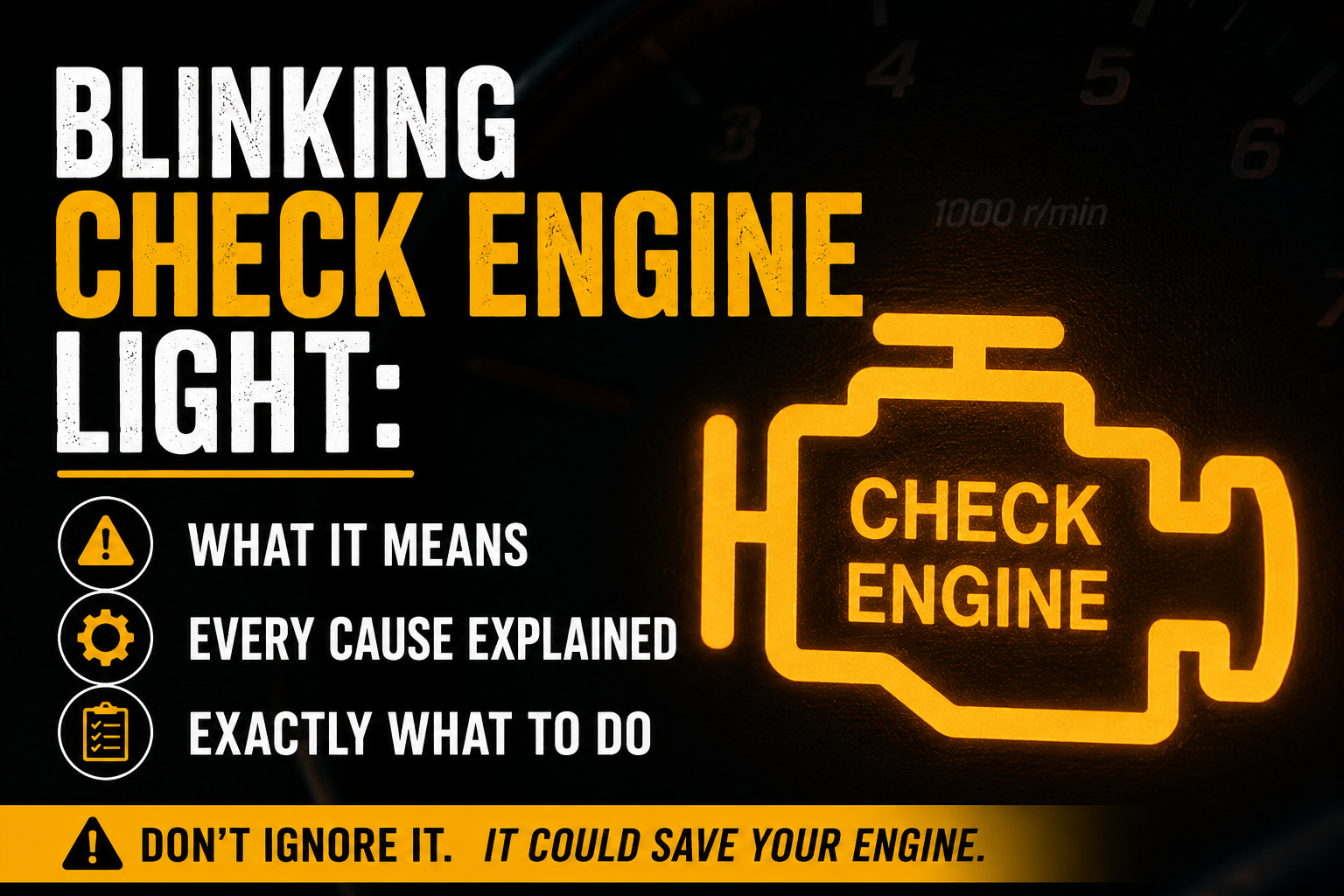
Blinking Check Engine Light: What It Means, Every Cause, and Exactly What to Do
⚠️ Act Now: If your check engine light is blinking — not solid, but actively flashing — this is
⚠️ Act Now: If your check engine light is blinking — not solid, but actively flashing — this is your car’s highest-priority warning. Pull over safely, turn off the engine, and do not continue driving. Every additional mile risks destroying your catalytic converter and turning a $200 repair into a $2,500+ one.
That blinking light on your dashboard isn’t like a regular check engine warning. It’s a completely different category of alert — one that most drivers have never encountered before and don’t know how to read correctly.
This guide explains exactly what a flashing check engine light means, why it’s fundamentally different from a solid one, every common cause behind it, what happens when you ignore it, and the precise steps to take right now. We also cover the specific combination of check engine light blinking with car shaking — one of the most searched and most alarming symptoms drivers face.
Blinking vs. Solid Check Engine Light: The Critical Difference
This is the most important thing to understand first, and most drivers don’t know it.
A solid (steady) check engine light means the car’s onboard computer — the Engine Control Unit, or ECU — has detected a problem and logged it as a stored fault. The issue may be minor (a loose gas cap, a faulty oxygen sensor) or moderate, but the car can typically be driven to a shop for diagnosis. It is a yellow-light caution signal: address it soon, but it’s not an immediate crisis.
A blinking or flashing check engine light means something entirely different. The ECU has detected an active, ongoing condition that is damaging the engine or emissions system right now, in real time. It is a red-light emergency signal: stop driving.
Think of it like this — a solid check engine light is your car saying, “Something’s off, get it looked at.” A blinking check engine light is your car saying, “I’m being damaged at this moment. Please stop.”
The reason automakers program the light to flash — rather than simply staying on — is specifically to convey urgency. The flashing pattern is designed to be impossible to mistake for a routine warning. If you see it blink, the appropriate response is the same as seeing your temperature gauge spike into the red zone or your oil pressure warning illuminate: pull over.
What a Blinking Check Engine Light Almost Always Means: Engine Misfire
In the overwhelming majority of cases, a flashing check engine light indicates one thing: active engine misfire.
An engine misfire occurs when one or more cylinders fail to properly ignite the air-fuel mixture during the combustion cycle. Instead of burning cleanly and powering the piston, unburned fuel passes directly into the exhaust system as raw, liquid gasoline.
That unburned fuel then enters the catalytic converter — a component designed to clean up normal combustion byproducts, not act as a post-combustion burner for raw fuel. When liquid gasoline hits the hot catalytic converter, its internal temperature spikes far beyond design limits. The ceramic honeycomb structure inside the converter — coated with precious metals (platinum, palladium, rhodium) that do the actual emission-conversion work — can crack, melt, or disintegrate completely.
This is why the light flashes rather than just illuminating steadily: the misfire isn’t historical, it’s happening right now, and the damage to your catalytic converter is cumulative with every minute you keep driving.
The ECU uses specific OBD-II diagnostic codes to identify misfires:
- P0300 — Random/multiple cylinder misfire detected
- P0301 through P0308 — Misfire in specific cylinder (P0301 = cylinder 1, P0302 = cylinder 2, etc.)
When you see any of these codes combined with a flashing check engine light, you have an active misfire. The specific cylinder code helps narrow down whether the problem is an ignition component, fuel delivery issue, or mechanical fault in that cylinder.
Why Is My Check Engine Light Blinking? All the Causes
While engine misfire is the primary trigger, several different underlying problems can cause the misfire and the subsequent flashing light. Here’s every cause, in order of frequency:
1. Worn or Fouled Spark Plugs
Spark plugs are the most common root cause of engine misfires. Each plug ignites the compressed air-fuel mixture in its cylinder thousands of times per minute. As they wear over time, their electrode gap widens, their tip erodes, and they may develop carbon deposits that prevent a clean spark. When a spark plug can no longer reliably fire, that cylinder misfires.
Conventional copper spark plugs typically need replacement around 30,000 miles. Iridium or platinum plugs last 60,000–100,000 miles depending on the manufacturer’s specification. Letting plugs go beyond their service interval is one of the most common setup conditions for a blinking check engine light.
Signs pointing to spark plugs: Rough idle even when the light first appeared as solid, gradual degradation in fuel economy before the flashing started, misfires at a specific cylinder (e.g., P0302).
Repair cost: $100–$300 for most vehicles, DIY-friendly with basic tools.
2. Failing Ignition Coils
Modern vehicles use coil-on-plug (COP) systems — one ignition coil per spark plug. These coils convert the 12-volt battery supply into the 20,000–40,000 volts needed to fire the plug. When a coil weakens or fails, the plug it serves doesn’t get enough voltage to produce a spark, and that cylinder misfires.
Coil failures often start intermittently — the light may appear only under load or at highway speed — and then progress to continuous misfiring. A practical DIY diagnostic trick: swap a suspected coil to a different cylinder. If the misfire code moves to the new cylinder (e.g., from P0302 to P0304), the coil is confirmed faulty.
Signs pointing to ignition coils: Misfire code follows a single cylinder, rough running that gets worse under acceleration or when the engine is warm, brief hesitation when accelerating.
Repair cost: $150–$400 per coil depending on vehicle, labor included.
3. Clogged or Failing Fuel Injectors
Each cylinder receives fuel through a precision injector that delivers exactly the right amount of atomized gasoline at exactly the right moment. Deposits, contamination, or injector wear can cause an injector to deliver too little fuel (lean misfire) or the wrong spray pattern, preventing proper combustion.
Fuel injector problems are more common in vehicles running on lower-quality fuel, those that rarely have fuel system service performed, or older high-mileage engines.
Signs pointing to injectors: Rough running that doesn’t track to a single cylinder, car shaking worsens at idle, smell of raw fuel from the exhaust, codes across multiple cylinders.
Repair cost: $150–$350 per injector for professional cleaning or replacement.
4. Weak Fuel Pump or Clogged Fuel Filter
The fuel pump delivers pressurized gasoline from the tank to the injectors. If the pump is weakening or the fuel filter is clogged, fuel pressure drops below the threshold needed for complete combustion. The result is a lean misfire — the cylinders are getting air but insufficient fuel — which can affect multiple cylinders simultaneously and trigger the flashing check engine light.
Running your tank very low repeatedly accelerates fuel pump wear, as the pump relies partly on the fuel itself for cooling.
Signs pointing to fuel delivery: Hard starts (especially when the engine is warm), hesitation or stumbling on acceleration, multiple-cylinder misfire codes (P0300), loss of power on hills or during heavy acceleration.
Repair cost: Fuel filter $50–$150; fuel pump replacement $300–$800 depending on vehicle.
5. Faulty Oxygen (O2) Sensor
Oxygen sensors measure the amount of oxygen remaining in the exhaust gases after combustion, sending real-time data to the ECU to fine-tune the air-fuel ratio. A failed O2 sensor sends incorrect data, causing the ECU to run the engine too rich (too much fuel) or too lean (too little fuel). Either condition can cause rough running and eventually a misfire severe enough to trigger the flashing light.
O2 sensors are more likely to cause a solid check engine light than a flashing one — but when the incorrect air-fuel ratio they create is severe enough to produce an active misfire, the light escalates to flashing.
Signs pointing to O2 sensors: Smell of rotten eggs from the exhaust (rich running burning sulfur compounds), reduced fuel economy before the misfire symptoms started, codes like P0131, P0136, P0141.
Repair cost: $150–$500 per sensor, depending on location and vehicle.
6. Mass Airflow (MAF) Sensor Failure
The MAF sensor measures the volume of air entering the engine so the ECU can calculate the correct fuel delivery. A dirty or failed MAF sensor sends incorrect airflow readings, disrupting the air-fuel ratio. This can cause rough idle, poor performance, and misfires bad enough to trigger the flashing warning.
MAF sensors are often contaminated by oil from aftermarket air filters, or simply by accumulated debris over time.
Signs pointing to MAF: Rough idle that comes and goes, black smoke from exhaust, poor throttle response, codes P0101–P0103.
DIY fix option: Many MAF sensors can be cleaned with specialized MAF sensor cleaner spray. If cleaning doesn’t resolve the codes, replacement is needed.
Repair cost: $100–$400 depending on vehicle.
7. Low Cylinder Compression
If a cylinder has low compression — caused by worn piston rings, a damaged valve, a blown head gasket, or a jumped timing component — it physically cannot compress the air-fuel mixture enough for it to ignite properly. The result is a mechanical misfire that won’t be solved by replacing spark plugs or coils.
Low compression misfires are more serious because they indicate internal engine wear or damage rather than a failed external component.
Signs pointing to low compression: Misfire code in one cylinder that doesn’t resolve after replacing plugs and coils, blue smoke from the exhaust (oil burning), coolant consumption or milky oil (head gasket), multiple symptoms across the engine.
Diagnosis: Requires a compression test or leak-down test — not a DIY job in most cases.
Repair cost: Varies significantly — from a few hundred dollars for a valve adjustment to several thousand for head gasket or timing chain repair.
8. EGR Valve Problems
The Exhaust Gas Recirculation (EGR) valve reduces nitrogen oxide emissions by recirculating a portion of exhaust gases back into the intake manifold. When the EGR valve gets stuck open or closed, it disrupts the air-fuel mixture and can cause rough running, misfires, and a flashing check engine light in severe cases.
Signs pointing to EGR: Rough idle, hesitation under acceleration, black smoke from exhaust, codes P0401–P0404.
Repair cost: $150–$700 for cleaning or replacement.
9. Vacuum Leak
Modern engines rely on a sealed intake system. Cracked or disconnected vacuum hoses introduce unmeasured air into the intake, leaning out the air-fuel mixture. Severe vacuum leaks can cause the engine to run so lean that misfires occur across multiple cylinders.
Signs pointing to vacuum leak: Hissing or sucking sound from the engine bay, high or erratic idle, lean codes alongside misfire codes.
Repair cost: Typically inexpensive — $50–$200 if it’s just a hose. More expensive if the intake manifold gasket has failed.
10. Catalytic Converter Damage (Effect, Not Cause)
The catalytic converter itself rarely triggers a flashing check engine light directly — it’s almost always an effect of the misfire rather than the cause. However, a converter that has already been severely damaged by previous misfires can become physically blocked, restricting exhaust flow to the point where the engine can’t breathe properly. This secondary restriction can trigger additional misfires and further worsen an already-deteriorating situation.
Check Engine Light Blinking and Car Shaking: What’s Happening
The combination of a flashing check engine light and car shaking is the most alarming symptom combination in this category — and it’s also the most diagnostically clear.
When your car shakes alongside the flashing light, you’re almost certainly experiencing a significant multi-cylinder misfire. Here’s the mechanical explanation:
A properly running engine produces smooth power pulses from each cylinder in sequence. When one cylinder misfires, the balance is disrupted slightly — you might feel a subtle roughness. When two or more cylinders misfire simultaneously, the imbalance becomes severe, and the entire engine vibrates. That vibration transmits through the engine mounts into the chassis, and you feel it through the steering wheel, seat, and floor as shaking.
The severity of shaking correlates directly with the severity of the misfire:
Mild shaking at idle that smooths out at speed: Usually a single-cylinder misfire, often ignition-related (spark plug or coil). Still serious — still don’t drive — but the root cause is likely a simpler fix.
Violent shaking at idle and under acceleration: Multi-cylinder misfire. Fuel delivery, MAF sensor, or severe ignition failure across multiple cylinders. Higher urgency, higher potential repair cost.
Shaking combined with loss of power, raw fuel smell from exhaust, or visible smoke: The catalytic converter may already be receiving unburned fuel and overheating. Pull over immediately.
Shaking combined with a rough, lurching sensation on acceleration: Classic signature of misfires occurring under load — the engine can’t produce consistent power when the cylinders aren’t all firing.
Other Causes of the Shaking + Flashing Light Combination
While misfire is the primary culprit, a few other issues can produce both symptoms together:
Failed motor mounts — worn engine mounts allow the engine to physically rock inside the engine bay, which can produce shaking and — if the movement disrupts sensors or wiring — trigger warning codes.
Transmission problems — a slipping transmission can produce shaking under acceleration and sometimes trigger the check engine light if it affects engine load calculations. However, transmission-related shaking without a true misfire typically won’t produce a flashing light.
Severe vacuum leak — enough to cause lean misfires across multiple cylinders, producing both the shaking and the flashing.
What Happens If You Keep Driving with the Check Engine Light Blinking?
This is what most people really want to know: can I just drive home? Can I make it to the shop?
The honest answer is: it depends on how far you’re going and how severe the misfire is, but the risk is genuinely high. Here’s the damage chain that unfolds when you continue driving:
Stage 1 (minutes): Unburned fuel enters the exhaust system and reaches the catalytic converter. The converter’s internal temperature rises above its design limit.
Stage 2 (continued driving): The ceramic honeycomb substrate inside the converter begins to crack. The precious metal catalyst coating is damaged or destroyed. The converter loses efficiency.
Stage 3 (extended driving): The damaged substrate can crumble into the exhaust flow, potentially entering the engine and causing cylinder scoring. The converter becomes physically blocked, restricting exhaust flow and causing additional mechanical damage.
Stage 4 (worst case): What started as a $150 spark plug or a $300 ignition coil becomes a $1,500–$2,500 catalytic converter replacement — or worse, internal engine damage requiring a rebuild.
A study found that only 36% of drivers get a check engine light inspected within a week of it appearing. That delay, acceptable for a solid light in some circumstances, is potentially catastrophic when the light is blinking.
What Does It Mean When the Check Engine Light Flashes Then Stops?
This is a common and particularly confusing scenario — the light blinks for a few minutes, then goes solid, or turns off entirely. Does that mean the problem fixed itself?
No. Here’s what actually happened:
The ECU detected an active misfire severe enough to trigger the flashing mode. The misfire may have then subsided temporarily — perhaps because the engine warmed up, you slowed down and reduced load, or the fault is intermittent. When the immediate severity drops below the threshold for flashing, the light reverts to solid or turns off. But the underlying fault condition — the failing spark plug, the weak coil, the marginal fuel injector — is still there.
An intermittent fault that causes the light to flash then stop is often more dangerous than a consistent one, because it can suddenly worsen during high-speed driving or under heavy load, catching you completely off guard.
If your check engine light flashed and then stopped: The problem is still there. The ECU has stored the fault code even if the light is now off. Use an OBD-II scanner to read stored codes, or take the vehicle to a shop for diagnosis. Do not dismiss it.
Step-by-Step: What to Do Right Now
Step 1: Pull Over Safely and Turn Off the Engine
Don’t accelerate to reach your exit or push to make it to a gas station. Reduce speed gently, signal, and find the first safe place to stop. Turn the engine off. Every minute of running with an active misfire is risk accumulating in the catalytic converter.
Step 2: Check for Obvious Issues First
Before calling for help, do a quick visual check:
- Gas cap: Is it loose? A loose gas cap can cause a steady check engine light, though rarely a flashing one. Tighten it, wait a few minutes, and see if the light behavior changes.
- Under the hood: Are there any obviously disconnected hoses, wires, or fluid leaks? Don’t touch anything on a hot engine, but look for visible disconnection.
- Smell: A strong raw fuel odor from the exhaust confirms fuel is reaching the catalytic converter unburned.
Step 3: Read the OBD-II Codes If You Have a Scanner
An OBD-II scanner plugs into the diagnostic port under your dashboard (usually beneath the steering wheel on the driver’s side). Turn the ignition to “on” without starting the engine, and let the scanner retrieve codes.
P0300–P0308 confirms a misfire. Write down every code the scanner returns, including any secondary codes alongside the misfire codes, as these can point directly to the cause.
If you don’t have a scanner, most auto parts stores (AutoZone, O’Reilly, Advance Auto Parts) offer free code reading — though you’ll need to get the car there safely first.
Step 4: Assess Whether to Drive or Call for a Tow
Drive only if:
- The light has reverted to solid (not still actively flashing)
- The engine feels smooth at idle with no shaking or rough running
- The distance to a shop is very short (under 2–3 miles)
- You’re traveling at low speed with no need for hard acceleration or load
Call for a tow if:
- The light is still actively blinking
- The car is shaking or running rough
- You smell raw fuel from the exhaust
- There’s any smoke, steam, or unusual sounds from the engine
- You’re on a highway and can’t make it somewhere safely at low speed
Towing costs $75–$150 on average. A destroyed catalytic converter costs $1,500–$2,500. The math is clear.
Step 5: Don’t Clear the Codes Without Fixing the Problem
A common mistake: clearing the OBD-II codes without repairing the underlying issue, hoping the light stays off. This doesn’t solve anything — the fault condition is still there, the codes will return, and you’ve erased the historical data (including freeze-frame data) that would have helped a mechanic diagnose the problem faster.
Clear codes only after the repair has been completed and verified.
Can I Fix a Blinking Check Engine Light Myself?
It depends entirely on the cause:
Yes, DIY is realistic for:
- Spark plug replacement (most vehicles) — basic tools, 1–2 hours
- Ignition coil replacement — slightly more involved but straightforward on most engines
- Replacing an O2 sensor — requires an O2 sensor socket but manageable
- Cleaning or replacing a MAF sensor — often a 15-minute job
- Tightening a loose gas cap
Professional help is strongly recommended for:
- Low compression diagnosis and repair (head gasket, timing components, valve work)
- Fuel injector flow testing and replacement
- EGR valve diagnosis (carbon cleaning vs. replacement)
- Any repair where the root cause isn’t clearly indicated by the codes
- Catalytic converter replacement (requires proper installation and often involves welding or specialized tools)
Common OBD-II Codes Associated with a Blinking Check Engine Light
| Code | Meaning | Likely Cause |
|---|---|---|
| P0300 | Random/multiple cylinder misfire | Multiple plugs/coils, fuel delivery, vacuum leak |
| P0301–P0308 | Specific cylinder misfire | Plug, coil, injector, or compression in that cylinder |
| P0171 | System too lean (Bank 1) | Vacuum leak, MAF sensor, O2 sensor, fuel pump |
| P0174 | System too lean (Bank 2) | Same as P0171, affects second cylinder bank |
| P0172 | System too rich (Bank 1) | O2 sensor, fuel injectors, fuel pressure regulator |
| P0351–P0358 | Ignition coil malfunction | Failed coil pack on specific cylinder |
| P0261–P0270 | Injector circuit malfunction | Failing or disconnected fuel injector |
| P0101–P0103 | MAF sensor range/performance | Dirty or failed MAF sensor |
| P0420 | Catalyst system efficiency (Bank 1) | Damaged catalytic converter (often a result of prolonged misfire) |
How to Prevent a Blinking Check Engine Light in the Future
Most flashing check engine light situations are preventable with routine maintenance:
Follow spark plug replacement intervals. This is the single highest-impact maintenance item. Iridium and platinum plugs last longer, but they still wear out. Check your owner’s manual for the recommended interval and don’t exceed it.
Service the fuel system every 30,000–50,000 miles. Fuel injector cleaning, fuel filter replacement, and fuel system additives help prevent deposit buildup that leads to misfires.
Replace air filters on schedule. A clogged air filter restricts airflow to the engine, disrupts the air-fuel ratio, and accelerates MAF sensor contamination. Most vehicles need a new air filter every 15,000–30,000 miles.
Address a solid check engine light promptly. A steady light ignored for weeks or months can degrade the underlying condition to the point where it triggers the flashing mode. Don’t let a yellow-light problem become a red-light emergency.
Don’t run the tank to empty repeatedly. Consistently low fuel starves the fuel pump of cooling and can accelerate wear. Keep the tank above a quarter.
Use quality fuel. Low-octane fuel in a vehicle that requires premium, or contaminated fuel from a high-turnover station with poorly maintained tanks, can cause temporary misfires.
Own an OBD-II scanner. A basic unit costs $30–$80 and pays for itself the first time you use it. Being able to read codes yourself — before the problem escalates — gives you a significant diagnostic advantage and helps you have a more informed conversation with your mechanic.