



What Is “Gelboodu”? Inside the Fake Keyword Fooling Google’s Top Results
Search “gelboodu” and you’ll get a full page of confident, detailed articles ready to explain exactly what it means.
Search “gelboodu” and you’ll get a full page of confident, detailed articles ready to explain exactly what it means. That’s the strange part. Look closer, and no two of them agree on what they’re explaining.
Three Definitions, Zero Agreement
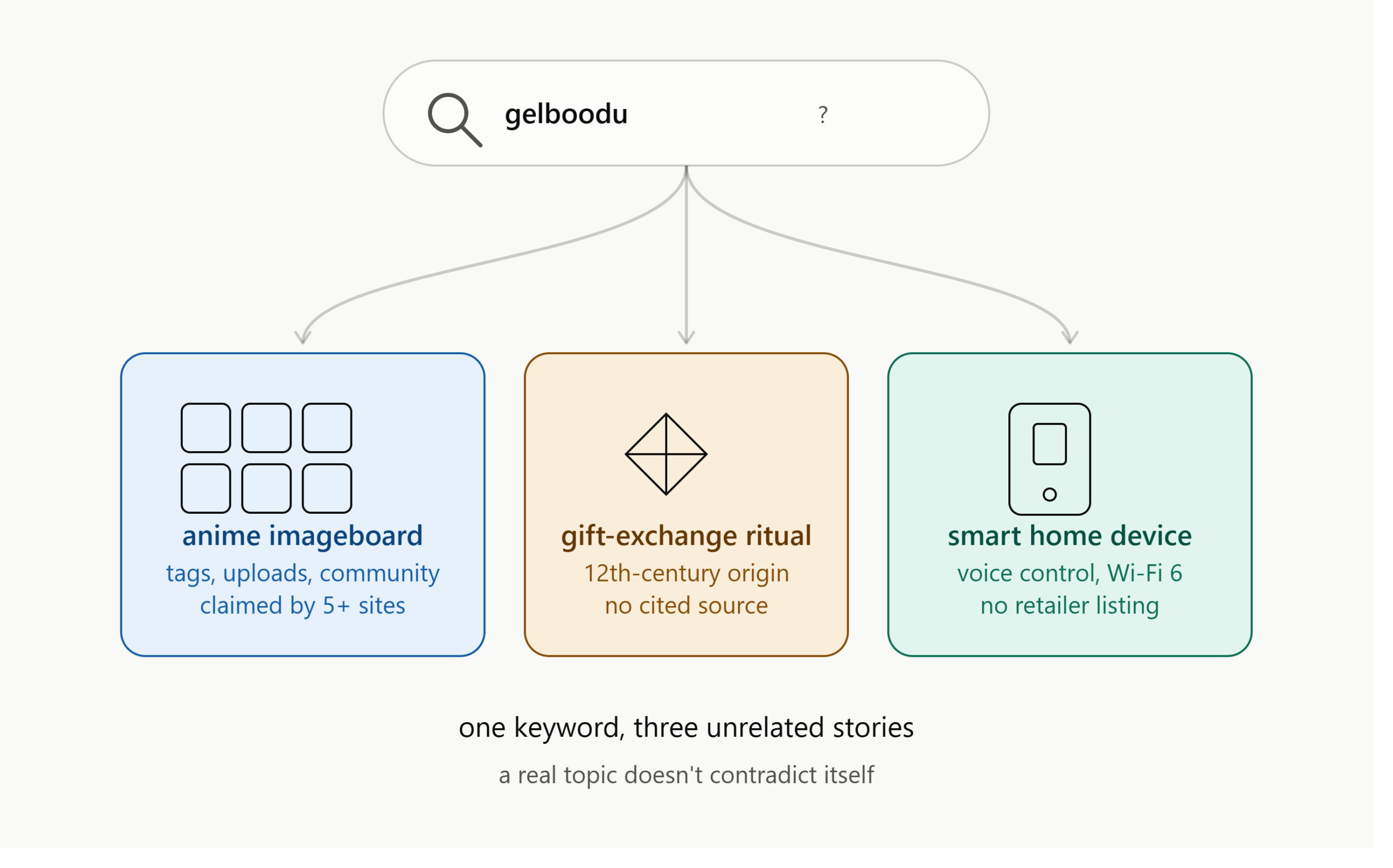
Pull up the first page of results and you’ll find “gelboodu” described as three entirely unrelated things, often by sites that look almost identical to each other:
- An anime-themed “imageboard” platform where users upload and tag artwork
- A centuries-old South Indian tradition of gift exchange between families during weddings
- An AI-powered smart home device with voice recognition and Wi-Fi 6
None of these definitions reference each other. None cite a shared origin. A word that actually meant something wouldn’t produce three contradictory identities across its top search results — it would produce one, told slightly differently by different writers. What’s happening here is something else.
How a Word Like This Gets “Defined” Into Existence
This is a pattern search engines have struggled with for years: a nonsense or extremely obscure term gets picked up by low-effort content operations, and instead of reporting that it means nothing, they simply invent a meaning and publish it with total confidence. A few signs give this away once you know what to look for:
- No original source. Legitimate topics — even niche ones — trace back to something: a company announcement, a news event, a cultural reference documented somewhere before the internet decided to write about it. None of the gelboodu content links back to an originating source for any of its three definitions.
- Suspiciously confident, detail-free history. The “South Indian tradition” version claims origins in the 12th century and formalization by the 17th century, with zero citations, historical records, or named sources. Real cultural history writing points to something — a text, a region-specific term in an actual language, an academic source. This doesn’t.
- Templated language across unrelated sites. Multiple domains explaining totally different “gelboodu” concepts still open with nearly identical framing: “In [x] world, gelboodu is becoming/has become a term of intrigue and curiosity.” That’s not a coincidence — it’s the fingerprint of AI-generated content built from the same prompt template, swapped across different fabricated topics.
- Filler phrases doing the work of substance. Lines like “Because of this wide range of meanings, many people become confused when they first encounter the word” sound like an explanation but don’t actually explain anything. It’s a sentence built to hit a word count, not to answer a question.
- The content answers questions nobody asked. Real search intent around a genuine topic is specific: people want to know if something is safe, how much it costs, how it works. These articles answer none of that concretely — they stay abstract because there’s no real subject underneath the words.
Why Would Anyone Build This?
The honest answer is traffic, and sometimes something more concerning. Search volume tools can pick up rising interest in oddly specific misspelled or invented terms — often because the term is a near-miss for something else people actually search for. Once a content farm spots that gap, publishing a fast, confident-sounding “explainer” page is cheap to produce and can rank quickly, especially against a keyword with no real competition, since nothing legitimate exists to outrank.
In gelboodu’s case, the “imageboard” cluster of results looks like it may be angling for traffic meant for a real, well-known anime image site with a very similar name — one associated with a large volume of unmoderated adult content. That’s worth taking seriously beyond the “annoying spam” framing: a reader who doesn’t realize what they’re clicking into can land somewhere with no content moderation and no warning about what’s actually there. Fabricated SEO content isn’t just a nuisance in cases like this — it can function as an unmarked on-ramp to something the searcher never intended to find.
How to Spot This Pattern Anywhere
Gelboodu is a useful case study because it makes the pattern so obvious, but the same tactics show up across all kinds of search results, especially for:
- Obscure product names or brand-adjacent terms
- Rare cultural or historical terms with no textbook presence
- Recently coined internet slang
- Misspellings of legitimate brands, platforms, or public figures
A few habits protect you regardless of the topic:
- Cross-check definitions across sources. If the top five results can’t agree on the basic category a term belongs to, treat all of them as unverified.
- Look for citations or named sources, not just confident tone. Confidence is cheap to generate; sourcing isn’t.
- Check the domain itself. Many of these pages sit on generic “magazine” or “news” domains that cover unrelated topics with the same templated structure — a strong sign of a content farm rather than a publication with actual expertise.
- Be cautious with unfamiliar terms tied to imageboards, “communities,” or “platforms.” If a definition steers you toward visiting an external site, verify what that site actually is before clicking through, rather than trusting the summary.
The Bigger Pattern
Gelboodu isn’t a one-off glitch in Google’s index. It’s a preview of what happens at scale when content generation becomes nearly free and publishing has almost no verification cost attached to it. A search engine optimized for matching keywords, not verifying truth, will keep surfacing whichever page answers a query most confidently — regardless of whether anything real backs it up.
The takeaway isn’t to distrust every unfamiliar search result. It’s to notice when a term’s own “explanations” contradict each other, and to treat that contradiction as the actual answer: not a real thing with three meanings, but no real thing at all, dressed up three different ways to catch three different slices of search traffic.