


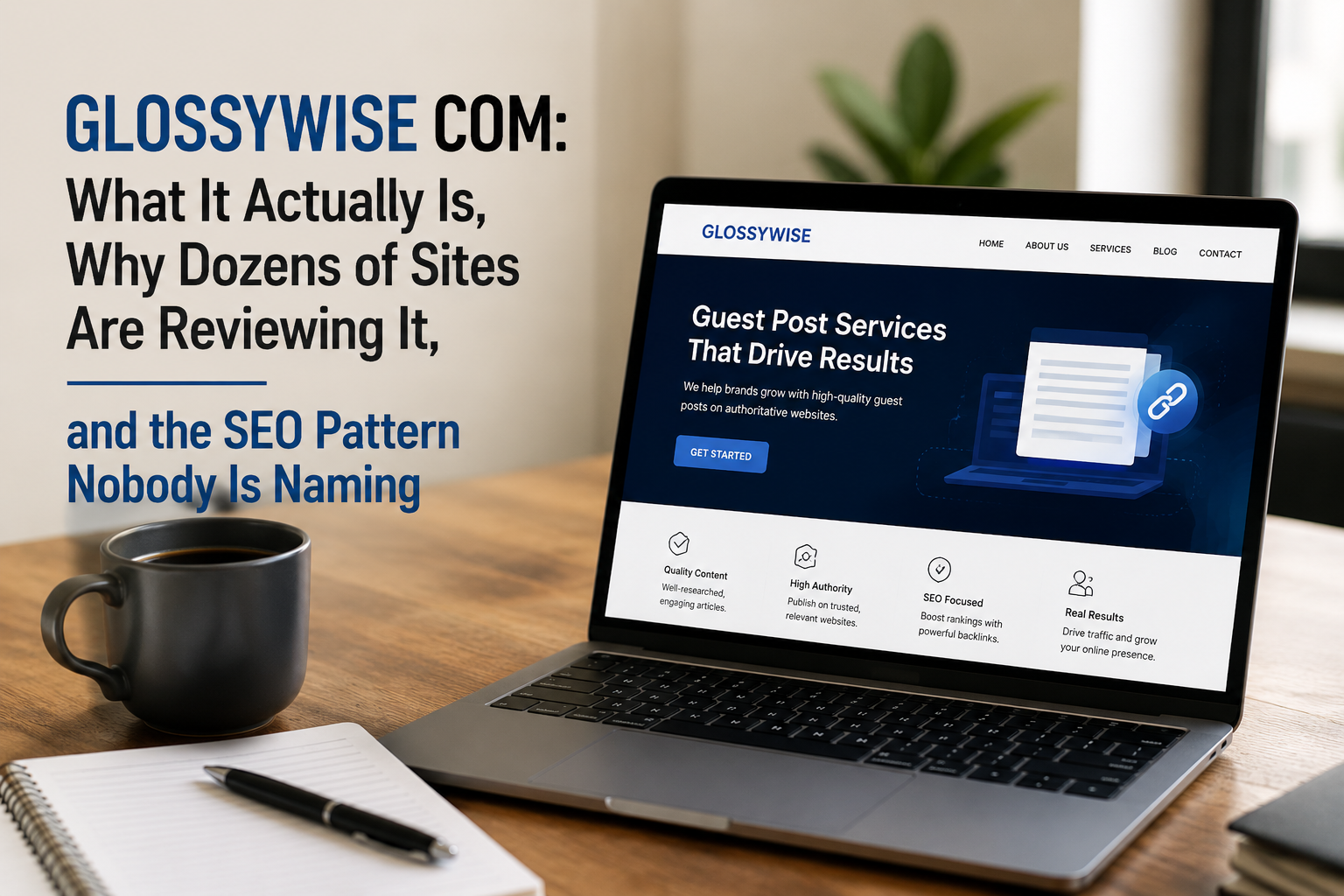
Glossywise Com: What It Actually Is, Why Dozens of Sites Are Reviewing It, and the SEO Pattern Nobody Is Naming
Search “glossywise com” and something unusual happens. You get not one or two review articles but ten — all
Search “glossywise com” and something unusual happens. You get not one or two review articles but ten — all published within weeks of each other, all structured identically, all reaching the same cautiously approving verdict. Sites you’ve never heard of reviewing a site you’ve never heard of. Each one concluding: “Worth bookmarking for casual reading. Use with caution for serious topics.”
It looks like organic reader curiosity producing independent analysis. It isn’t.
This article covers what Glossywise.com actually is, what can and cannot be verified about it, and — more importantly — the coordinated SEO pattern that manufactured a search trend around its name. Understanding that pattern doesn’t just help you evaluate one website. It changes how you read search results permanently.
What Is Glossywise.com? The Verified Facts
Glossywise.com is a multi-niche content website. It publishes articles across categories including lifestyle, beauty, health, technology, business, crypto, finance, travel, shopping, and real estate. The site is free to browse, requires no account or subscription, and adds new content regularly.
So far, so ordinary. Thousands of sites match that description.
What makes Glossywise worth examining more carefully is not the site itself but the gap between what it claims to be and what it actually publishes.
The site’s About section presents Glossywise as a platform focused on fashion, beauty, lifestyle, and wellness. The live category navigation tells a different story. Alongside beauty and lifestyle content, the site actively publishes articles on cryptocurrency, trading, real estate investment, finance, and technology. These categories require fundamentally different expertise from each other. A credible beauty platform and a credible crypto information site are built differently, staffed differently, and held to different standards of accuracy.
Glossywise does not explain the expansion. No editorial note. No change of scope announcement. No reasoning for why a beauty and wellness platform is also publishing crypto security guides. The categories simply exist, side by side, without context.
This matters for how readers calibrate trust. If a site defines its identity one way and publishes another way, readers have no stable basis for evaluating what they’re reading.
What Cannot Be Verified
Several things about Glossywise.com are not publicly available:
Ownership. No named founder appears on the site. No company registration or business entity is disclosed. The About page references a platform philosophy, not a team.
Editorial policy. How articles are reviewed, fact-checked, or approved is not documented publicly.
Author credentials. The site displays author bylines, but author backgrounds are not verifiable from within the site. A byline is not the same as a credential.
Traffic. No verified third-party traffic data for the domain is publicly available at the time of writing.
None of these gaps prove the site is operating in bad faith. Plenty of legitimate small publishers have incomplete transparency infrastructure. But readers deserve to know what they can and cannot check — and right now, the answer is: not much.
The Editorial Identity Problem
The mismatch between self-description and actual content is Glossywise’s most documented issue, flagged in at least three independent analyses.
Startupeditor.com noted it directly: the site’s About messaging focuses on fashion, beauty, lifestyle, and wellness, while the actual category structure is much wider. The site also publishes content in business, crypto, education, finance, food, gaming, health, home, real estate, shopping, technology, trading, travel, and world topics.
Medium’s analysis made the same observation: while the site does feature author bylines, the authors’ credentials are not always clearly defined, which raises questions about the expertise behind the content. In some cases, the About Us section presents the site as focusing on fashion, beauty, and lifestyle, but the content spans much broader topics.
This creates a specific problem for readers. When you visit a site with a clear editorial identity — a dedicated dermatology publication, a regulated financial news outlet, a peer-reviewed health platform — you calibrate your trust accordingly. When a site’s identity is unstable, you cannot calibrate at all. You are reading without a baseline.
The responsible approach: treat every Glossywise article as a standalone piece, evaluate it on its individual sourcing and argumentation, and do not extend trust earned from a lifestyle article to a cryptocurrency article on the same domain.
The SEO Pattern Nobody Is Naming
Here is the more interesting story.
Between April and July 2026, at least ten separate websites published articles reviewing Glossywise.com. All of them targeted the same keyword: “glossywise com.” All of them followed the same structure. All of them reached the same conclusion.
The sites include: moderynly.com, rooflio.com, irvixo.com, nimvee.com, tarziq.com, punstation.com, thebritishreport.com, baddiehu.wordpress.com, and two articles from medium.com and startupeditor.com.
Look at those sites. Not one of them is a major publication. Not one has a verifiable editorial team. Not one has a clear company registration, a named editor-in-chief, or a documented fact-checking process. Each one is itself a multi-niche content website — the same structure as Glossywise — reviewing another multi-niche content website.
Several cross-link to each other’s reviews of the same network of platforms: Zavalio.com, VocalNewsMedia.com, Alaikas.com, Methatreams. The pattern repeats across all of them. One review site links to the next, which links to the next, each one writing approximately the same article about approximately the same kind of site.
This is SEO keyword manufacturing. It works like this:
A group of similar websites identify a low-competition branded keyword. The keyword may be organic — someone genuinely searched the name — or it may be seeded deliberately by the site being reviewed, or by a network of affiliated accounts. Either way, the keyword exists and has low competition, meaning a relatively thin article can rank for it without significant effort.
Each site in the network publishes a review article targeting that keyword. The articles link to each other, generating backlinks that signal authority to search engines. The search trend grows as the articles rank. More searchers find the articles. The impression of organic interest accumulates.
From the outside, it looks like ten independent voices reviewing one website. From the inside, it is one network generating ten pieces of content that point at each other.
The tell is in the structure. Every article in the Glossywise review cluster shares identical headings: “What Is It?” followed by “Is It Safe?” followed by “Features” followed by “Final Verdict.” Every article concludes with mild approval. None are critical enough to discourage a click. None investigate the site’s ownership, its traffic, or the pattern generating the reviews.
That last part is the most important. The reviews are not independent analysis. They are participation in the same ecosystem they appear to be evaluating.
What “Open Publishing Platform” Actually Means
Glossywise operates as an open publishing platform, meaning writers and creators can contribute articles. Multiple review sites cite this as a feature. None explain what it implies.
An open publishing platform can mean many things. At one end of the spectrum sits Wikipedia — open contributions, documented editorial standards, citation requirements, dispute resolution, and thousands of active editors policing quality. At the other end sit content farms with zero editorial oversight, where any contributor can publish anything and the platform benefits from advertising revenue regardless of accuracy.
Most open platforms fall somewhere between those poles. The question is where.
For Glossywise, the answer is unclear. No documented editorial standards appear on the site. No submission guidelines are publicly visible. No review or approval process is described. What the open platform structure does guarantee is that content quality varies by contributor — because contributors have different knowledge, different standards, and different motivations.
This is not a reason to dismiss the site. It is a reason to evaluate individual articles rather than trusting a site-level reputation. An article on a well-researched lifestyle topic from an experienced contributor may be genuinely useful. An article on cryptocurrency security from an unverified contributor on the same platform may be dangerously wrong.
The site is the same. The content is not.
How to Verify Any Website Independently
The Glossywise review ecosystem is a useful case study in why independent verification matters — because the reviews themselves cannot be trusted to provide it. Here are the tools that can.
WHOIS lookup (whois.domaintools.com). Shows domain registration date, registrar, and whether ownership is privacy-protected. A newly registered domain with privacy-protected ownership and no traffic history is worth noting. Domain age alone does not determine legitimacy, but a site claiming established authority with a six-month-old domain should raise a question.
Wayback Machine (web.archive.org). Shows historical snapshots of the site. If Glossywise launched as a beauty platform and pivoted to crypto within six months, the Wayback Machine shows that shift. Topic pivots are not inherently dishonest, but unexplained pivots affecting high-stakes content areas deserve scrutiny.
ScamAdviser (scamadviser.com). Automated trust scoring based on domain age, hosting location, and technical signals. Use it as one data point, not a verdict. Scamadviser scores legitimate new sites poorly and occasionally misses genuinely harmful ones.
SimilarWeb or Semrush free tier. Estimated traffic data and traffic sources. A site claiming a large readership with negligible measurable traffic is a discrepancy worth understanding. It may reflect very recent launch, may reflect organic search dependency, or may reflect inflated claims.
Google Search: site:[domain]. Shows how many pages Google has indexed. A site with 10,000 indexed pages and minimal domain authority suggests a high-volume, low-quality publishing approach. A site with 200 indexed pages and strong topical focus suggests something different.
What you’re looking for across all of these: Named, verifiable editorial leadership. Consistent topic focus that matches self-description. Sourced articles with checkable author credentials. Domain age appropriate to claimed authority. Transparent contact and ownership information.
Most sites — including many respected ones — will fail at least one of these checks. The goal is not to find perfection. It is to understand what you are working with before you rely on it.
Is Glossywise.com Worth Reading? The Calibrated Answer
For casual, low-stakes browsing on lifestyle, beauty, or general wellness topics, Glossywise functions as a reasonable starting point. The content is accessible, the site loads cleanly, and there is no documented harm from visiting it.
For health decisions, financial choices, legal questions, or cryptocurrency security, it is not suitable as a sole or primary source. Not because it is definitely wrong — some articles may be accurate — but because the editorial infrastructure to guarantee accuracy on high-stakes topics does not appear to exist.
The same standard applies to most free multi-niche content platforms, regardless of how many review articles approve them. Approval from a network of similarly structured sites is not independent endorsement. It is echo.
Calibrated use: read Glossywise articles the way you would read any anonymous online content. Check the claim. Find the primary source. Apply the same skepticism you would apply to an anonymous forum post. If the article gives you useful general orientation on a low-stakes topic, that is genuine value. If it is telling you how to secure a crypto wallet or manage a health symptom, verify it elsewhere before acting.
People Also Ask: Quick Answers
What is Glossywise.com? Glossywise.com is a multi-niche content website publishing articles across lifestyle, beauty, health, technology, crypto, business, and travel. It operates as an open publishing platform allowing external contributors. The site has no clearly disclosed ownership, no named editorial leadership, and no verifiable author credentials for individual articles.
Is Glossywise.com legit? It is a real, functioning website with no confirmed fraud reports. However, “real” and “trustworthy” are different standards. The site lacks transparent ownership, named editorial staff, and verifiable credentials. Appropriate for casual reading; not appropriate as a sole source for health, finance, or legal decisions.
Why are so many sites reviewing Glossywise.com? Because “glossywise com review” is a low-competition keyword targeted simultaneously by a network of similar multi-niche sites. This is SEO keyword manufacturing — sites generating artificial search volume through coordinated interlinked review content. The trend reflects content strategy, not genuine independent reader curiosity.
Who owns Glossywise.com? Ownership is not publicly disclosed on the site. No named founder, company registration, or verifiable editorial leadership page exists. WHOIS registration for the domain is privacy-protected. This lack of transparency is consistent across every independent analysis of the platform.
Is Glossywise.com safe to visit? Browsing the site carries no identified security threats. Standard habits apply: avoid entering personal or financial information, verify health or financial claims through authoritative sources, and apply appropriate skepticism to anonymous content.
What is SEO keyword manufacturing? A coordinated pattern where a network of websites creates artificial search volume around a brand name by publishing interlinked review articles simultaneously. Each site links to the others, generating backlinks and search signals that make the trend appear organic. The result: ten reviews that look independent but function as one.