



Kate and William’s Nanny Received a Royal Award: Everything About María Teresa Turrión Borrallo and the Royal Victorian Medal
For over a decade, she has been the quietly indispensable presence in the Wales household — at school gates,
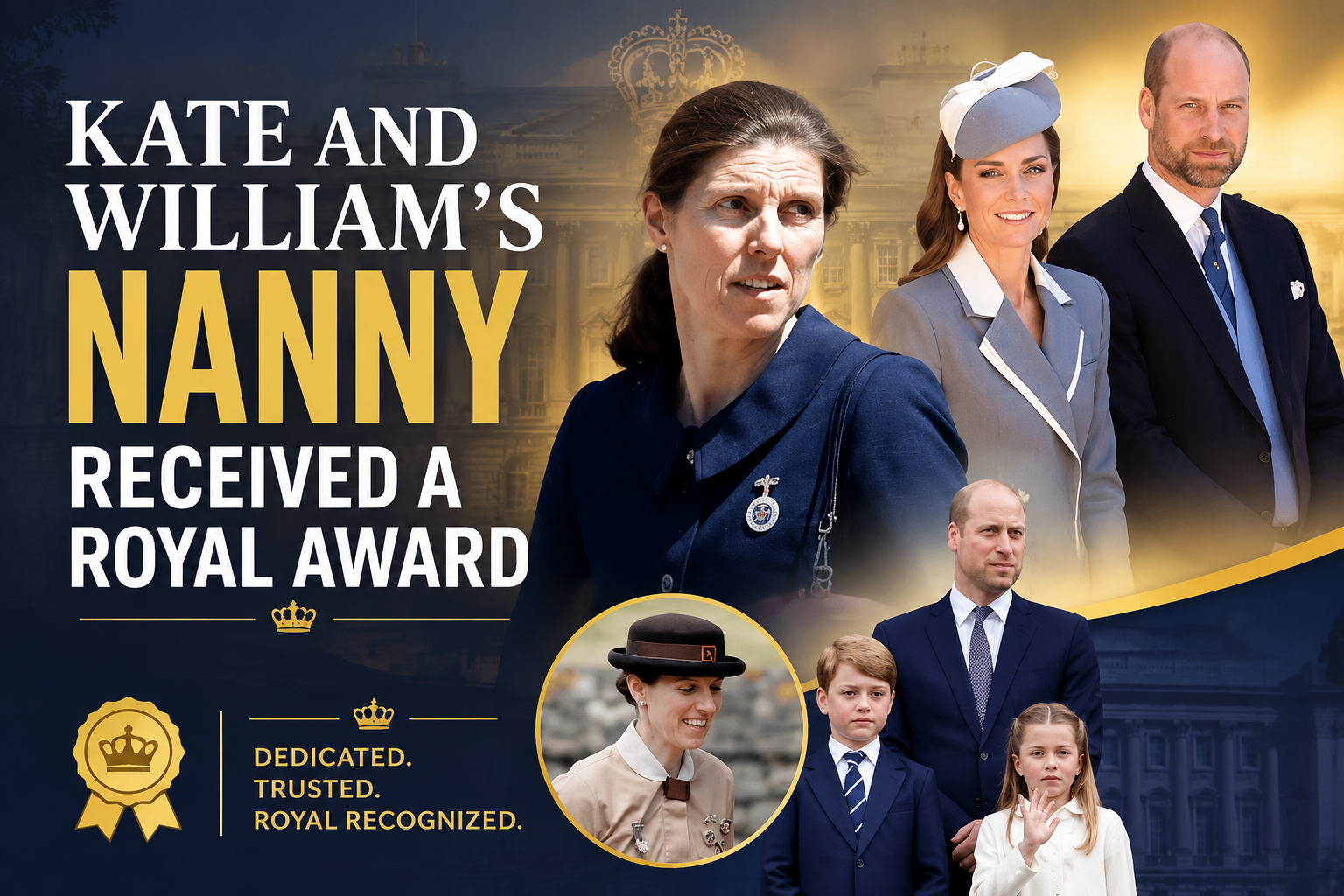
For over a decade, she has been the quietly indispensable presence in the Wales household — at school gates, on royal tours, in the background of historic family photographs. And in March 2026, after eleven years of discreet, devoted service, María Teresa Turrión Borrallo stepped briefly into the spotlight to receive one of the British monarchy’s most personal honours.
Prince William and Kate Middleton’s nanny received a Royal Victorian Medal in Silver — presented by Prince William himself at an investiture ceremony at Windsor Castle on March 24, 2026. The award, announced in King Charles’s 2026 New Year Honours List, recognised her exceptional service to the Prince and Princess of Wales over eleven years of caring for Prince George, Princess Charlotte, and Prince Louis.
For a woman whose entire professional reputation rests on discretion, the public acknowledgement was unusually significant. This is everything you need to know about the award, the woman who received it, and what her story reveals about the extraordinary world of royal childcare.
What Award Did Kate and William’s Nanny Receive?
María Teresa Turrión Borrallo, 54, received the Royal Victorian Medal in Silver — an honour awarded at the sole discretion of the monarch, without input from government ministers or independent committees.
The award was announced in King Charles III’s 2026 New Year Honours List, published on December 29, 2025. The investiture ceremony took place on March 24, 2026, at Windsor Castle, where Prince William personally presented the medal to Borrallo — a moment that royal commentators described as rare and emotionally meaningful.
The citation recognised her “exceptional service to the Prince and Princess of Wales.”
What Is the Royal Victorian Medal? Why Is It Special?
The Royal Victorian Medal sits in a distinctive place within the British honours system, and understanding why requires knowing how it differs from the honours most people recognise.
Most prestigious British honours — MBEs, OBEs, CBEs, knighthoods — are awarded on the advice of government ministers and overseen by independent committees. They recognise public service, achievement in the arts, sport, or business, and contributions to public life. The process is formal, bureaucratic, and governmental.
The Royal Victorian Medal is different in almost every respect. Established in 1896 by Queen Victoria, it is awarded purely at the monarch’s personal discretion — directly expressing gratitude from the royal family, not the state. No committee decides who receives it. No minister advises on the list. The King alone determines who has provided the kind of loyal, personal, and exceptional service to the royal household that merits recognition.
This makes it one of the most intimate honours the Crown can bestow. It is not about public achievement — it is a private thank-you, made public.
The Royal Victorian Medal comes in gold and silver grades. Borrallo received the silver medal, as did Lance Sergeant Scott Robin Bishop, the Wales family’s long-serving driver, who was honoured at the same investiture ceremony for his own loyal service to the couple.
The fact that both were included in the same New Year Honours List offered an unusually rare glimpse into the private world of the Wales family — publicly acknowledging individuals who typically work entirely in the shadows.
Who Is María Teresa Turrión Borrallo?
Background and Origins
María Teresa Turrión Borrallo is a Spanish national, born and raised in Palencia, a city in the Castile and León region of northern Spain. She trained at Norland College in Bath — the most prestigious nanny training institution in the world — before eventually becoming part of one of the most scrutinised households on earth.
She is 54 years old and has worked with the Wales family since 2014, when she was appointed shortly after Prince George’s birth.
The Norland College Training
To understand what makes Borrallo’s background remarkable, you have to understand Norland College. Founded in 1892 in Bath, the college has trained professional nannies for 134 years and is in the process of being reclassified as a full university — reflecting the academic depth and rigour of its curriculum.
Norland’s three-year programme is simultaneously practical and theoretical. As Elspeth Pitman, Norland Nanny and Head of Graduates, explained: “High-profile families recognise the high level of training our students have. It’s three years, it’s practical, it’s theoretical. They can support with the psychology elements; they can support with the care of the child. We teach them about working with the whole family, with other professionals. The training is extensive.”
The curriculum covers child development and psychology, nutrition and anti-fussy-eating strategies, security awareness and personal protection, household management, formal etiquette and protocol, and discretion and confidentiality — a non-negotiable skill for any Norland graduate placed with a high-profile family.
Norland nannies are recognisable by their distinctive brown uniform — a brown dress to the knee with a white collar, completed with a brown bowler hat, specifically designed to distinguish nannies from other palace or household staff. It’s the uniform Borrallo has been photographed wearing on formal and semi-formal occasions with the Wales family for over a decade.
Graduates typically earn starting salaries above £50,000, with experienced nannies in high-profile placements earning over £100,000. Reports have suggested Borrallo’s salary is in the region of $155,000 (approximately £119,000) — reflecting both her experience and the exacting demands of the role.
Norland even operates its own recruitment agency, guaranteeing graduates employment upon completion of their training — a reflection of the sustained demand for their specifically credentialled childcare professionals.
Eleven Years with the Wales Family: Borrallo’s Role and Responsibilities
How It Began
Borrallo joined the Wales household in 2014 when Prince George was just eight months old. The appointment was made official when the family — then the Duke and Duchess of Cambridge — announced she would accompany them on their royal tour of New Zealand and Australia, her first public appearance with the family.
The announcement at the time was characteristically brief: “Maria will be with us full-time. We will not be providing any further details about her, except that the Duke and Duchess are, of course, delighted that she has chosen to join them.”
She has since cared for Princess Charlotte, now 10, and Prince Louis, now 7 — present from each child’s earliest months, through christenings, school years, family tours, and the ordinary daily routines that make up a child’s world.
Living Arrangements
For the family’s years at Kensington Palace, Borrallo lived with the Wales family full-time as a resident nanny. When the family moved to Adelaide Cottage in Windsor in 2022 — a deliberate choice by William and Kate to create a more normal home life for their children — the arrangement changed. Borrallo no longer lives with the family, though she remains closely involved in the children’s daily lives.
The decision reflects the Wales family’s well-documented commitment to giving their children as grounded and ordinary a childhood as their circumstances allow.
What a Royal Nanny Actually Does
As the Wales children have grown older and all three now attend school, Borrallo’s role has evolved considerably. Fellow Norland-trained nanny Louenna Hood, author of Your Baby’s First Year, has described what the daily rhythm looks like for a nanny working with school-age children:
“With children at school during the day, you are required to organise school pick-ups and plan logistics of the different pick-up times due to after-school sports and clubs. Organisation is key to making each child have a filling breakfast, fuelling them for a busy day at school. And remembering to send the children to school each day in the right uniform or sports kit.”
Beyond logistics, the role is emotional as much as practical. Car journeys, Hood noted, often prove to be the most valuable moments: “Car journeys usually prove a great place to become a listening ear, so you understand what your charge is finding difficult at school or what they are particularly enjoying.”
The nanny’s responsibilities across the children’s lives have included:
- Managing the daily school routine — breakfasts, pick-ups, uniforms, sports kit, and after-school activities
- Homework support and academic encouragement
- Nutrition and mealtimes — Norland nannies are trained in approaches that prevent children from becoming fussy eaters, including the rule that children must always try a bite of everything, regardless of preference
- Travel — accompanying the family on royal tours and trips abroad, providing continuity and stability for the children during disrupted routines
- Language education — Borrallo has made daily Spanish practice a non-negotiable part of the children’s routine, which fits with the Wales family’s broader interest in languages. Prince William speaks several languages including French, Welsh, and Spanish
- Being a consistent presence through major royal occasions — Borrallo has been seen at events including royal weddings and Trooping the Colour, typically remaining at the margins, quietly watching the children
The Strict Rule She Keeps
One detail that stands out about Borrallo’s approach is her firm commitment to language learning. The Spanish-born nanny has ensured that Prince George, Princess Charlotte, and Prince Louis speak Spanish daily — treating it not as an optional enrichment activity but as a structured, consistent part of their upbringing.
Given that George is 12 and approaching secondary school, the three royal children have now been learning Spanish as a daily practice for most of their lives — a remarkable head start that will benefit them throughout their adult royal duties.
The Skills Nobody Talks About
What most coverage of royal nannies doesn’t mention is the security dimension of Norland training. The college prepares graduates to work in high-profile and potentially high-risk environments — training that includes situational awareness and, reportedly, adapted Taekwondo techniques specifically designed for scenarios such as protecting a pram from a potential kidnapper.
In a household where the children are future heirs to the British throne, this kind of training isn’t theoretical.
A Rare Public Moment for a Private Professional
What made the March 2026 investiture so striking to royal watchers was its rarity. Borrallo’s professional identity has been built entirely on invisibility — on being present for everything but seen by no one outside the family. The fact that her name appeared in the New Year Honours List, and that she was publicly honoured at a Windsor Castle ceremony, represented an unprecedented moment of recognition for someone whose success depends entirely on staying out of the spotlight.
The investiture was not accompanied by public photographs or video of Borrallo — a discretion that reflected the privacy she has maintained throughout her tenure. But the ceremony happened, the medal was presented by Prince William personally, and the acknowledgement was unambiguous.
Royal commentators described it as “a rare, emotional acknowledgement that the future of the Crown doesn’t grow up alone.” One report characterised her role this way: “She was there for first steps no cameras saw. For night-time fears during royal tours. For the quiet routines that make extraordinary childhoods feel normal. In a life defined by scrutiny, Maria was consistency.”
The Wales Family’s Approach to Parenting and the Nanny’s Role
Prince William and Princess Kate are consistently described as hands-on parents by the standards of the modern royal family — they do school pick-ups, attend sports days, and have been deliberately more present in their children’s daily lives than previous generations of royals. The Princess of Wales has been noted to insist on handling certain parenting tasks herself, rather than deferring to the nanny.
But Borrallo’s role is not diminished by their hands-on approach — it is complemented by it. The couple’s demanding schedule of official engagements, royal duties, and international travel makes continuous parental presence impossible. Borrallo provides the consistency that their schedules cannot always allow: the familiar face at breakfast when a parent has an early engagement, the presence that makes a school run feel routine when everything else in the Wales children’s lives is far from ordinary.
As the Wales children grow — George is heading to secondary school in September 2026 — the role will continue to evolve. But royal sources note that Borrallo remains an integral part of the family, valued precisely because the children have known her their entire lives.
The Broader Significance: Royal Nannies and the Crown
Borrallo is far from the first nanny to play a defining role in a royal childhood. The tradition of employing professional nannies goes back generations within the British royal family, with some figures becoming almost as famous as the royals themselves.
The most celebrated was Mabel Anderson, who cared for Prince Charles, Princess Anne, Prince Andrew, and Prince Edward, and was awarded the Royal Victorian Order — a higher rank in the same family of royal personal honours — for her service.
What’s changed in the Wales household is the degree of parental involvement. Earlier generations of royals had nannies who were, in many ways, the primary caregivers. William and Kate have explicitly broken from that model — but retained professional support, in Borrallo, that allows them to fulfil both their parenting values and their public duties.
The Royal Victorian Medal, awarded now for her service, represents something beyond personal gratitude. It is an acknowledgement that the carefully managed, quietly sustained stability she has provided to three children who will one day represent the British monarchy — one of whom, George, will be king — carries genuine value that the Crown wished to formally recognise.
Frequently Asked Questions
Who is Kate and William’s nanny? María Teresa Turrión Borrallo, a Spanish national from Palencia, trained at Norland College in Bath. She has worked with the Prince and Princess of Wales since 2014, caring for Prince George, Princess Charlotte, and Prince Louis.
What award did Prince William and Kate Middleton’s nanny receive? She received the Royal Victorian Medal in Silver, announced in King Charles III’s 2026 New Year Honours List and presented by Prince William at an investiture ceremony at Windsor Castle on March 24, 2026. The citation recognised her “exceptional service to the Prince and Princess of Wales.”
Why is the Royal Victorian Medal significant? Unlike most British honours, the Royal Victorian Medal is awarded purely at the monarch’s personal discretion — not on the advice of government ministers. It is a direct, personal expression of gratitude from the royal family for loyal and exceptional service, making it one of the most intimate honours the Crown can bestow.
How long has the nanny worked for William and Kate? Since 2014 — over eleven years. She joined the household when Prince George was eight months old and has cared for all three Wales children throughout their lives.
Where did the Wales family’s nanny train? At Norland College in Bath, the world’s most prestigious nanny training institution, founded in 1892. The college offers a three-year programme covering child development, psychology, security awareness, nutrition, and household management. It is expected to be reclassified as a full university in 2026.
Does the nanny live with the Wales family? Not currently. When William and Kate moved from Kensington Palace to Adelaide Cottage in Windsor in 2022, they opted not to have live-in staff — a deliberate choice to create a more normal home life for their children. Borrallo previously lived with the family full-time during the Kensington Palace years.
What does Kate and William’s nanny earn? Reports suggest a salary in the region of $155,000 (approximately £119,000), consistent with the upper end of Norland College graduate salaries for high-profile placements. Norland graduates typically start at above £50,000, with experienced nannies earning over £100,000.