




What Is Fibermaxxing? The UK Guide to 2026’s Biggest Health Trend
Somewhere between protein-obsessed gym culture and the great matcha takeover, fibre was quietly waiting. Fibermaxxing is TikTok’s name for
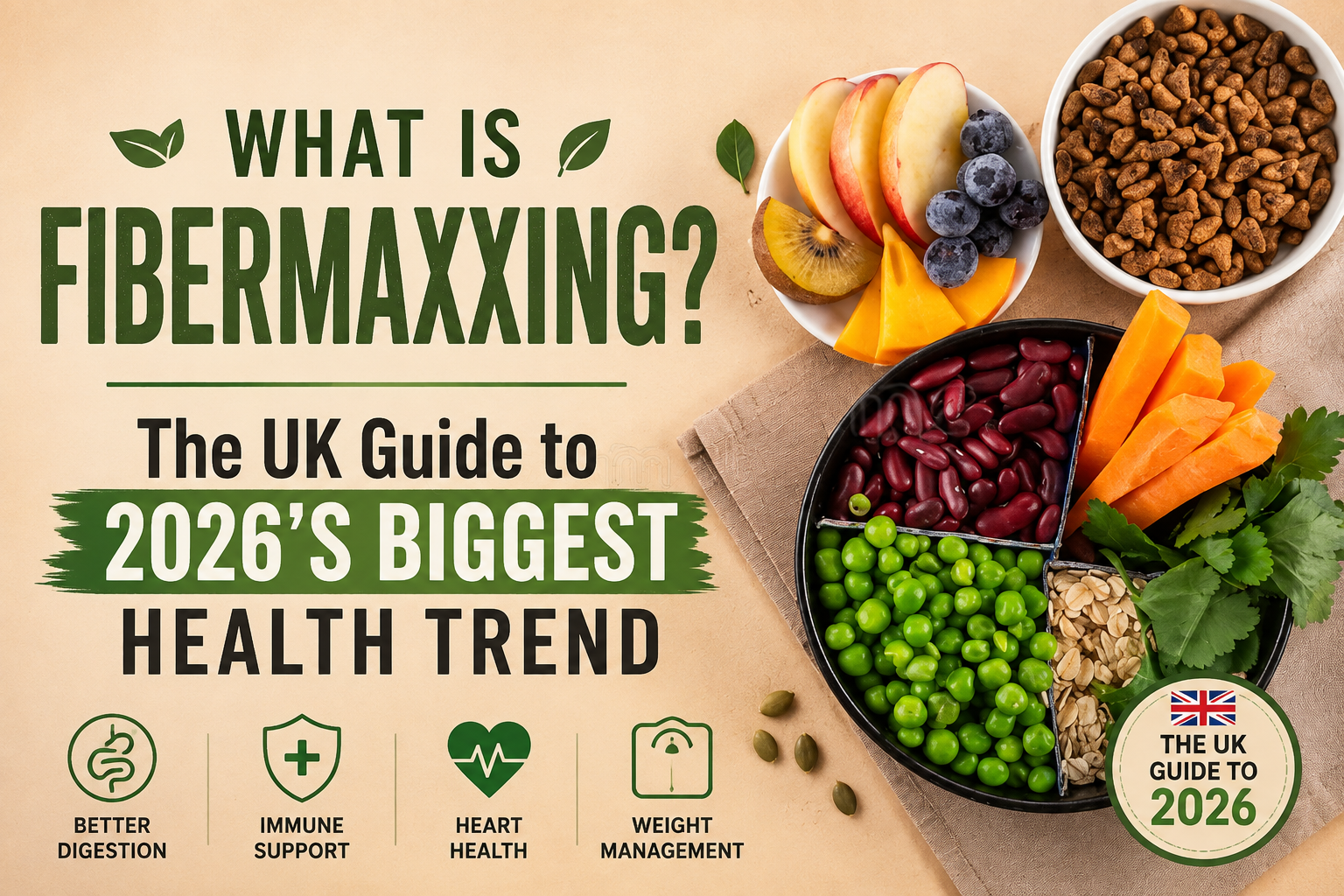
Somewhere between protein-obsessed gym culture and the great matcha takeover, fibre was quietly waiting.
Fibermaxxing is TikTok’s name for something nutritionists have been recommending for decades: intentionally eating more fibre, at every meal, every day. The hashtag has accumulated millions of views. Health professionals — including gastroenterologists who openly call themselves “fibre obsessed” — are posting alongside the influencers. The McDonald’s and PepsiCo CEOs have both cited it as a top food trend for the year ahead.
And here is the part that makes it genuinely different from most wellness trends: the science is not disputed. The NHS recommends it. Decades of research support it. The only problem is that almost nobody in the UK is actually doing it.
This article is for informational purposes only and does not constitute medical advice. Consult your GP if you have a digestive condition before significantly increasing your fibre intake.
Quick Answer
Fibermaxxing means intentionally increasing the amount of dietary fibre you eat by adding fibre-rich foods to every meal and snack. There is no official programme or clinical definition — it is a social media label for established nutrition advice. UK guidance recommends adults eat around 30g of fibre per day. National Diet and Nutrition Survey data found that UK adults average roughly 16 to 17g daily, with only 4% meeting the recommendation. Fibermaxxing simply means trying to close that gap.
What Is Fibermaxxing?
Fibermaxxing means intentionally increasing the amount of dietary fibre you eat, usually by adding fibre-rich foods to every meal and snack. There is no official programme, approved food list or clinical definition. It is a social-media label for established nutrition advice — most people would benefit from eating more fibre from a varied diet.
The name follows the “-maxxing” suffix pattern that TikTok has applied to various self-optimisation trends. Looksmaxxing. Sleepmaxxing. Mouthmaxxing. In each case, the framing is about maximising a specific input for maximum benefit. Fibermaxxing is the version that nutrition experts find easiest to endorse.
Hannah Holscher, a professor of nutrition at the University of Illinois, told NPR: “The truth of the matter is, I kind of appreciate the trend because generally, fibre is just not really a sexy nutrient that people are paying attention to and basically, no one eats enough fibre.” That is an academic’s way of saying: finally.
The UK Fibre Gap Is Significant
The reason fibermaxxing has attracted serious attention in the UK is not the trend itself — it is the context it sits in.
UK guidance from the Scientific Advisory Committee on Nutrition recommends that people aged 16 and over average around 30g of fibre per day. The National Diet and Nutrition Survey, covering 2019 to 2023, found that UK adults average roughly 16 to 17g daily. Only 4% of UK adults meet the recommendation.
That gap — between 30g recommended and 16g actual — has existed for years. What fibermaxxing does is give people a simple, memorable framing to address it. Add more fibre at each meal. Think about it intentionally rather than passively. That is essentially the entire method.
The population-level implication is real. Fibre intake is one of the most robust predictors of long-term health in epidemiological research, and the UK gap between guidance and reality is one of the largest nutritional deficits in the country.
What Does Fibre Actually Do?
This is the section worth reading before you start adding chia seeds to everything.
Fibre’s primary job is in the gut — it feeds the microbiome, the ecosystem of bacteria that lives in your large intestine and has a significantly wider influence on your health than most people realise.
Certain fibres provide fuel for gut bacteria, which produce compounds called short-chain fatty acids. These have anti-inflammatory effects, support the gut lining, and influence everything from immune function to mood regulation through the gut-brain axis.
Beyond the microbiome, the research is consistent. Consuming adequate fibre helps reduce your risk of developing obesity, reduces your risk of cardiovascular disease, type 2 diabetes, and lowers your risk for certain types of cancer — especially colorectal cancer. It can also help manage blood sugar levels and, yes, research has found it lowers the risk of dying prematurely.
A varied intake from different plant foods is generally more useful than relying heavily on one source, because different plants contain different types of fibre and additional nutrients. An apple, a handful of lentils, some oats, and a portion of broccoli each bring something distinct to the microbiome — the variety matters as much as the volume.
Types of Fibre Worth Knowing
Not all fibre behaves the same way, and understanding the broad categories helps you choose more deliberately.
Soluble fibre dissolves in water and forms a gel-like substance in the gut. It slows digestion, helps control blood sugar, and reduces cholesterol. Found in oats, barley, apples, citrus fruit, carrots, and beans.
Insoluble fibre does not dissolve — it adds bulk to stools and speeds transit through the bowel, reducing constipation and lowering colorectal cancer risk. Found in wholegrain bread, brown rice, nuts, seeds, and the skins of vegetables and fruits.
Prebiotic fibre specifically feeds beneficial gut bacteria. Found in garlic, onions, leeks, bananas, Jerusalem artichokes, and chicory. This is the category most directly connected to microbiome diversity.
A fibermaxxing approach works best when it draws on all three categories rather than optimising for one.
How to Actually Do Fibermaxxing in the UK
The most common mistake, according to nutrition experts, is changing too much too quickly. Adding 15g of fibre overnight when your gut is used to 16g is a reliable way to spend several uncomfortable days. Go slowly. Drink water. The gut microbiome needs time to adjust.
Here is a practical framework for building toward 30g without overhauling your entire diet:
Breakfast: Swap processed cereal for porridge (3g fibre per portion) or add a tablespoon of ground flaxseed to yoghurt. Add berries. A banana on the side. That alone gives you 6–8g before 9am.
Lunch: Add a handful of mixed beans to a salad, swap white bread for wholegrain, or include a portion of lentil soup. Beans and legumes are the most efficient fibre delivery per gram of food — a tin of chickpeas contains around 7g.
Dinner: Roast your vegetables rather than boiling them (retains more fibre structure). Leave the skins on potatoes. Add a side of green vegetables — a portion of broccoli gives around 2.6g. Swap white rice for brown or add a mixed grain.
Snacks: A small handful of mixed nuts (2–3g). An apple with the skin on (4g). Hummus with carrot sticks (4–5g combined).
Hannah Holscher suggests aiming for five different fibre sources each day as a practical goal. “Do I have an apple and orange banana that’s sitting in my fruit bowl? Can I open up my fridge and pull out some carrots, celery and berries? And then in my pantry, I’ve got a bag of nuts. Or I’m making overnight oats before I head out the door.”
That is fibermaxxing. It is not complicated.
UK Foods With the Highest Fibre Content
| Food | Portion | Fibre |
|---|---|---|
| Split peas (boiled) | 80g | 5.5g |
| Red lentils (boiled) | 80g | 3.8g |
| Chickpeas (tinned) | 80g | 4.1g |
| Wholegrain pasta | 75g dry | 6.3g |
| Oats (porridge) | 40g dry | 3.0g |
| Chia seeds | 1 tbsp (10g) | 3.6g |
| Avocado | ½ fruit | 4.6g |
| Apple (with skin) | 1 medium | 4.4g |
| Broccoli (boiled) | 80g | 2.1g |
| Flaxseed (ground) | 1 tbsp | 2.8g |
Most UK supermarkets label fibre content per 100g on packaging — check the per-portion figure rather than per-100g when comparing products.
Does Fibermaxxing Help With Weight Loss?
This is the question that brings a significant portion of the fibermaxxing audience in, and it deserves an honest answer.
High-fibre foods are generally more filling than low-fibre equivalents because they slow digestion and extend the feeling of satiety. Replacing ultra-processed low-fibre foods with whole plant foods tends to reduce overall calorie intake without deliberate restriction. In that sense, a higher-fibre diet often supports weight management as a secondary benefit.
But fibermaxxing is not a weight-loss method with a controlled evidence base. The benefits for cardiovascular health, cancer risk, and metabolic function are robust and well-established. The weight effects are real but indirect — a consequence of eating more whole foods, not a mechanism of fibre itself.
If weight management is your primary goal, fibre is a useful tool among several rather than a standalone solution.
Fibermaxxing and the GLP-1 Connection
One of the more interesting dimensions of the trend’s timing is its relationship to the Ozempic and Mounjaro moment in the UK.
GLP-1 medications slow gastric emptying — meaning food moves through the digestive system more slowly, which reduces appetite. Fibre has a similar, milder effect on gastric transit. Several nutritionists now recommend higher fibre intake specifically for people on GLP-1 medications, both to maximise satiety and to maintain gut health during a period when overall food intake drops significantly.
If you are on a weight-loss injection and eating significantly less, maintaining fibre intake from a smaller volume of food becomes more important, not less — because the gut microbiome still needs feeding even when overall calories are reduced.
Who Should Be Careful
Fibermaxxing is appropriate for most healthy adults. There are specific situations where caution is warranted.
Irritable bowel syndrome (IBS): Some types of fibre — particularly high-FODMAP foods like onions, garlic, apples, and beans — can worsen symptoms in people with IBS. The low-FODMAP diet, often recommended by NHS dietitians for IBS, involves restricting some of the same foods that fibermaxxing enthusiasts celebrate. If you have IBS, speak to a dietitian before significantly increasing fibre.
Inflammatory bowel disease (IBD): Crohn’s disease and ulcerative colitis require individual dietary assessment. High-fibre eating may not be appropriate during flares.
Kidney disease: High dietary oxalate from some fibre sources (spinach, rhubarb, nuts) can be a consideration for people with a history of kidney stones.
For the majority of healthy UK adults currently averaging 16–17g of daily fibre, gradually increasing to 25–30g is safe, evidence-based, and one of the most impactful nutritional changes they can make.
The Takeaway
Fibermaxxing is the rare wellness trend that nutritionists, gastroenterologists, and the NHS can all agree on — because it is not a new idea. It is decades of established dietary guidance with a TikTok rebrand and a generation of people actually paying attention to it for the first time.
The UK fibre gap is real. Only 4% of adults meet the 30g daily recommendation. The health consequences of that gap — in cardiovascular disease, type 2 diabetes, and colorectal cancer risk — are well-documented.
Adding more fibre gradually, from varied sources, is not glamorous. It is an apple, a handful of lentils, overnight oats, and the skin left on your jacket potato. It is the dietary equivalent of going to bed at a reasonable hour — obvious, effective, and consistently undervalued.
You might also like:
- Is Melatonin Legal in the UK? What You Can Actually Buy
- Can You Get Ozempic on the NHS? The Honest 2026 Answer
- Browse all Health on Vivid Magazine
Frequently Asked Questions
What is fibermaxxing? Fibermaxxing means intentionally increasing the amount of dietary fibre you eat at every meal and snack. It is a TikTok-coined term for established nutrition advice — the UK recommendation is 30g of fibre per day, but UK adults average only 16–17g. Fibermaxxing simply means trying to close that gap through deliberate food choices.
Does fibermaxxing actually work? Yes — for the benefits supported by research. Higher fibre intake is robustly associated with reduced risk of cardiovascular disease, type 2 diabetes, colorectal cancer, and premature death. It also supports gut microbiome health and can help with satiety and appetite management. The science is not new — the trend is just giving it attention.
How much fibre should I eat per day UK? UK guidance recommends around 30g of fibre per day for adults aged 16 and over. Most UK adults currently eat 16–17g, with only 4% meeting the recommendation. The most practical approach is to add one or two additional fibre sources at each meal rather than calculating totals obsessively.
What are the best high-fibre foods in the UK? Split peas, red lentils, chickpeas, wholegrain pasta, oats, chia seeds, avocado, apples (with skin), broccoli, and ground flaxseed are among the most fibre-dense foods readily available in UK supermarkets. Variety matters — different plant foods feed different gut bacteria.
Can fibermaxxing cause side effects? Yes, if you increase intake too quickly. Adding large amounts of fibre to a low-fibre diet overnight commonly causes bloating, gas, and digestive discomfort. The consistent advice from nutrition experts is to increase gradually over two to four weeks and drink more water alongside the additional fibre.