


Can You Get Ozempic on the NHS? The Honest 2026 Answer
Ozempic is everywhere. Celebrities mention it in interviews. TikTok is full of before-and-afters. Your group chat has almost certainly
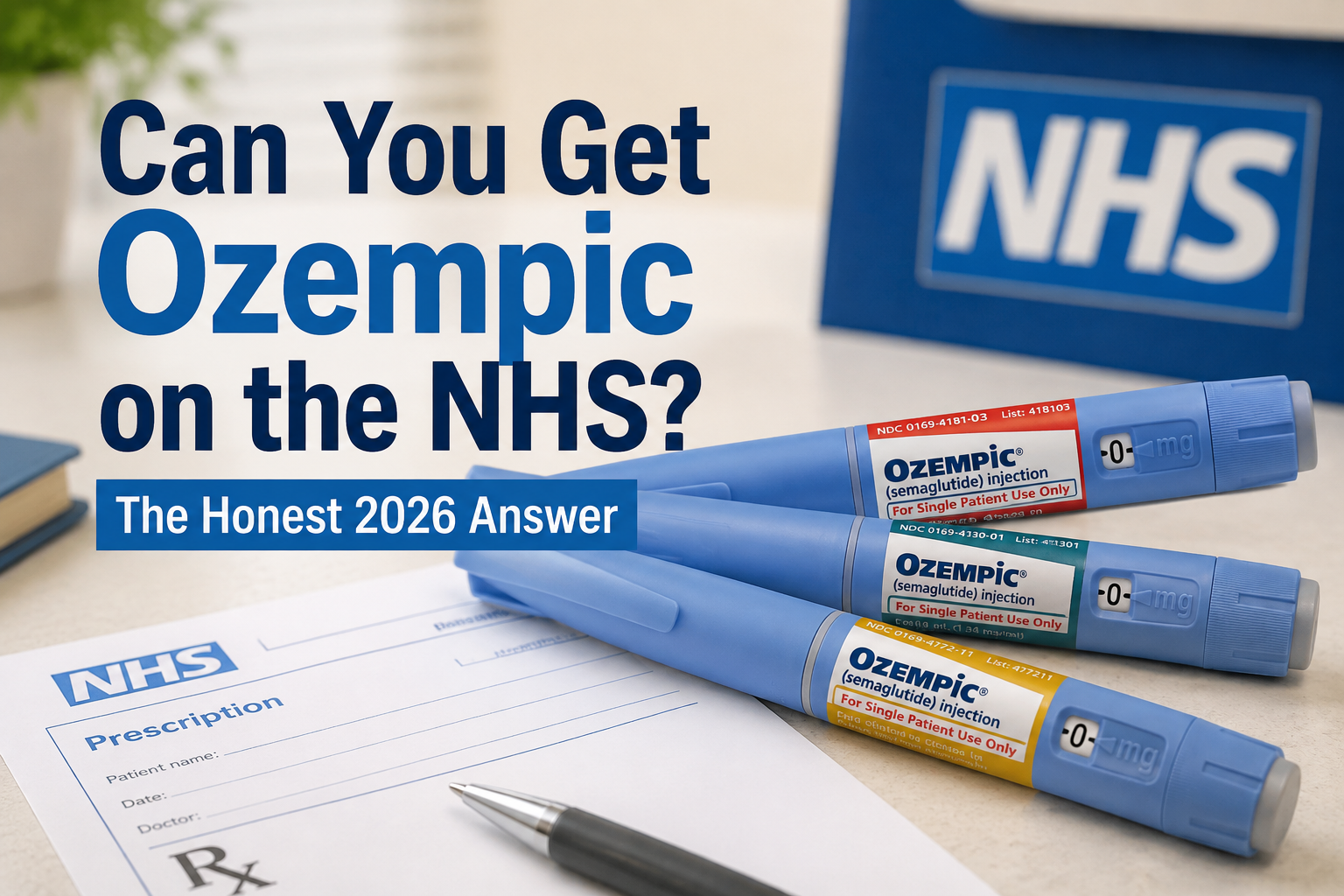
Ozempic is everywhere. Celebrities mention it in interviews. TikTok is full of before-and-afters. Your group chat has almost certainly discussed it. And when most people finally ask their GP about it, the answer is more complicated than they expected.
The short version: yes, you can get Ozempic on the NHS — but almost certainly not for the reason you want it. The NHS only prescribes Ozempic for type 2 diabetes. If you are looking for it as a weight loss treatment, you will be directed elsewhere. Whether that “elsewhere” works for you depends entirely on your specific situation.
This guide cuts through the confusion — what Ozempic actually is, who can get it on the NHS, what the weight-loss alternatives are, and what your options look like if you do not meet the criteria.
This article is for informational purposes only and does not constitute medical advice. Always consult a qualified GP or healthcare professional about your individual circumstances.
Quick Answer
Yes — you can get Ozempic on the NHS, but only if you have type 2 diabetes. It is not prescribed on the NHS for weight loss. The weight-loss version of the same active ingredient is Wegovy — same drug, higher dose, different licence. Both Wegovy and Mounjaro are now available on the NHS for weight management, but eligibility is strict, the rollout is phased, and waiting lists are long. If you do not meet NHS criteria, private prescribing is the main alternative.
What Is Ozempic and Why Does Everyone Want It?
Ozempic is the brand name for semaglutide, a medication that belongs to a class of drugs called GLP-1 receptor agonists. It was developed to treat type 2 diabetes by helping the body regulate blood sugar — it stimulates insulin production, slows digestion, and reduces appetite as a secondary effect.
That secondary effect is where the cultural moment came from.
Ozempic was originally intended as a treatment to help people with type 2 diabetes manage their blood sugars. But patients quickly started experiencing weight loss as a side effect, and so the medication manufacturer relicensed semaglutide for weight loss — and called it Wegovy.
The cultural explosion that followed was driven partly by celebrity usage, partly by social media, and partly by the fact that clinical trial results were genuinely striking. Demand surged. Acute shortages were reported between 2022 and early 2025, with official guidance advising that Ozempic be reserved for people living with type 2 diabetes to protect supply. Those shortages have largely resolved — but the NHS position has not changed. Ozempic remains a diabetes medication as far as NHS prescribing is concerned.
Can You Get Ozempic on the NHS?
Yes, Ozempic is available on the NHS as a type 2 diabetes treatment, but you cannot get Ozempic on the NHS for weight loss. That’s because, although it contains semaglutide — the same active ingredient as Wegovy — Ozempic is licensed for managing blood sugar levels and is available in lower dosages for this reason.
To qualify for Ozempic on the NHS for type 2 diabetes, you need to meet the NICE NG28 criteria. In practice, this means:
- A confirmed diagnosis of type 2 diabetes
- HbA1c levels above 58 mmol/mol after optimised first-line treatment
- Metformin at its maximum tolerated dose
- At least one other glucose-lowering medication already tried
Getting an Ozempic prescription on the NHS usually follows a set pathway. Your GP diagnoses type 2 diabetes, starts you on metformin, and monitors your HbA1c after three to six months. If blood sugar remains above the threshold after additional medications, GLP-1 receptor agonists like Ozempic may be considered.
What it costs: You can get Ozempic for free on the NHS in England if you are prescribed it to manage type 2 diabetes and you are over 60 or hold a medical exemption certificate. Under 60 without an exemption, you pay the standard NHS prescription charge of £9.90 per item. Prescriptions are free for everyone in Scotland, Wales, and Northern Ireland.
If you do not have type 2 diabetes, your GP cannot prescribe you Ozempic on the NHS. That is not a grey area — it is explicit NHS policy.
Ozempic vs Wegovy vs Mounjaro: Cleared Up
The three names that appear constantly in this conversation refer to three distinct licensed products, even though two of them contain the same active ingredient.
| Drug | Active Ingredient | NHS Licensed For | Weight Loss Licensed |
|---|---|---|---|
| Ozempic | Semaglutide | Type 2 diabetes | ❌ No |
| Wegovy | Semaglutide | Weight management | ✅ Yes |
| Mounjaro | Tirzepatide | T2D + weight loss | ✅ Yes |
Ozempic and Wegovy contain the same active ingredient but are not the same. Wegovy is licensed for weight loss, while Ozempic is not. They are also available in different dosages to reflect their use. Ozempic doses run up to 2mg weekly for diabetes management. Wegovy runs up to 2.4mg, with the MHRA approving a new 7.2mg top dose in January 2026 for weight management.
Mounjaro is different again. Mounjaro contains tirzepatide, which mimics two appetite hormones — GLP-1 and GIP — rather than one. A study published in the New England Journal of Medicine in 2025 found that people on tirzepatide lost 20.2% of their body weight over 72 weeks, while those on semaglutide lost 13.7%. The clinical difference is meaningful.
When people search for how to get Ozempic for weight loss, they are usually asking about semaglutide-based treatment more broadly — and in that context, Wegovy is the correct licensed product.
Can You Get Wegovy or Mounjaro on the NHS for Weight Loss?
Yes — but the eligibility bar is high and the rollout is deliberate.
Mounjaro has been available on the NHS through specialist weight-management services since March 2025, for people who meet the NICE criteria. From June 2025, it also became the first weight-loss injection a GP can prescribe directly, through a phased rollout starting with those with the highest clinical need. Wegovy is available only through specialist weight-management services, not from a GP.
Current NHS eligibility (2026):
The phased rollout means access is being introduced in stages:
- Now: BMI of 40 or above with at least four obesity-related health conditions
- From June 2026: BMI 35 or above with four qualifying conditions
- From March 2027: BMI 40 or above with three qualifying conditions
For individuals from South Asian, Chinese, other Asian, Middle Eastern, Black African or African-Caribbean backgrounds, BMI thresholds are reduced by 2.5 kg/m² due to higher clinical risk at lower BMI levels.
Qualifying conditions include type 2 diabetes, hypertension, dyslipidaemia (abnormal cholesterol), obstructive sleep apnoea, and cardiovascular disease.
NHS England plans to roll Mounjaro out to 220,000 people by the end of 2027, through specialist weight-management clinics, GP surgeries, and community clinics that must also offer lifestyle and physical activity support.
One important caveat: access depends heavily on where you live. Each region is managed by an Integrated Care Board (ICB), which decides how services are funded and delivered. Some areas have well-developed specialist clinics. Others still face long waiting lists. Your postcode directly affects your waiting time.
How to Get Referred on the NHS
Patients cannot self-refer for NHS-funded weight management medication. Referrals need to be initiated in primary care — through your GP.
In practice, this is how the process works:
Step 1 — Book a GP appointment. Come prepared with your BMI, a list of any weight-related health conditions you have been diagnosed with, and a record of what you have already tried — previous diets, programmes, medications.
Step 2 — Clinical assessment. Your GP will assess whether you meet the current NICE criteria based on BMI and qualifying conditions. They may also review your cardiovascular risk and overall health picture.
Step 3 — Referral or direct prescription. If you qualify and your ICB offers the service, your GP can now prescribe Mounjaro directly for eligible patients. Wegovy still requires a referral to a Tier 3 specialist weight management service.
Step 4 — Wait. Demand significantly outstrips current NHS capacity. Waiting times vary by region — in some areas, patients wait months; in others, over a year.
Wegovy treatment on the NHS is funded for up to two years and is continued only if you have lost at least 5% of your starting weight after six months. Mounjaro is reviewed regularly and continued as long as it is helping, alongside the lifestyle support that comes with the programme.
What If You Don’t Qualify? Private Options
If you do not meet NHS criteria or are facing a long wait, private prescribing is the main alternative.
Private prescribers generally work to lower BMI thresholds — most require a BMI of 30 or above, or 27.5 or above with a weight-related condition. January 2026 GPhC guidance means reputable private providers now carry out a fuller clinical assessment rather than relying on a simple online questionnaire. This is a meaningful improvement in safety standards.
Mounjaro prices were increased by the manufacturer in September 2025, making Wegovy the most affordable weekly weight-loss injection for private patients. Typical private costs range from approximately £150 to £300 per month depending on the product and provider.
Before using any online pharmacy:
Check the GPhC (General Pharmaceutical Council) register directly. The EU common logo no longer applies to pharmacies in Great Britain after Brexit, so it is no longer a reliable trust signal. The GPhC’s voluntary internet pharmacy logo and their public register are now the correct verification tools.
Do not buy semaglutide or tirzepatide from unlicensed sellers on major online marketplaces. Unregulated products with wildly inaccurate dosages have been found in the UK market — the risks are specific and real.
Ozempic Safety and Side Effects: What to Know
Before asking your GP about any GLP-1 medication, it is worth knowing what comes with it.
Common side effects (particularly when starting or increasing dose): nausea, vomiting, diarrhoea, constipation, stomach pain. These typically improve as the body adjusts, but they can be significant in the first few weeks.
Serious but rare: pancreatitis; thyroid C-cell tumours flagged in animal studies (significance in humans not confirmed but worth noting).
Not suitable for: people who are pregnant or planning pregnancy; those with a personal or family history of medullary thyroid carcinoma or Multiple Endocrine Neoplasia syndrome type 2; people with type 1 diabetes; those with a history of pancreatitis.
Drug interactions: warfarin, certain other diabetes medications, and some oral contraceptives may be affected. Always disclose all current medications to the prescriber.
If you stop the medication without having built sustainable lifestyle habits around it, weight regain is likely. In the SURMOUNT-4 trial, people who stopped tirzepatide and switched to a placebo regained much of the weight they had lost, while those who kept taking it largely maintained their results. These medications work while you take them — they are not a permanent reset.
The Takeaway
The answer to “can you get Ozempic on the NHS” is technically yes — but in the way you probably want it, the answer is no. Ozempic is a type 2 diabetes medication and the NHS treats it as one. For weight management, Wegovy and Mounjaro are the NHS-sanctioned routes, with eligibility criteria that prioritise the highest clinical need first.
The rollout is expanding in June 2026 and again in March 2027. If you do not qualify now, the criteria may reach you sooner than you expect.
If you do not want to wait, private prescribing is available — but only through properly registered providers following the 2026 GPhC standards. The NHS pathway is slower. It is also safer, monitored, and free at the point of use if you qualify. It is worth the conversation with your GP before going anywhere else.
You might also like:
Frequently Asked Questions
Can you get Ozempic on the NHS for free? Yes — if you are prescribed Ozempic for type 2 diabetes and you are over 60 or hold a medical exemption certificate. Under 60 without an exemption, you pay the standard £9.90 prescription charge per item in England. Prescriptions are free in Scotland, Wales, and Northern Ireland. Ozempic is not available free on the NHS for weight loss.
Can I ask my GP for Ozempic for weight loss? No. NHS guidance is explicit that Ozempic is only funded for type 2 diabetes management. Your GP cannot prescribe it for weight loss on the NHS. If you want a weight-loss injection on the NHS, ask about Mounjaro or Wegovy and whether you meet the current eligibility criteria.
What is the difference between Ozempic and Wegovy? Both contain semaglutide, but they are licensed for different uses. Ozempic is licensed for type 2 diabetes at doses up to 2mg weekly. Wegovy is licensed for weight management at doses up to 2.4mg (with a new 7.2mg top dose approved in January 2026). The NHS prescribes Ozempic for diabetes and Wegovy for weight management through specialist services.
How do I qualify for weight loss injections on the NHS? Currently you need a BMI of 40 or above with at least four obesity-related health conditions, including options like type 2 diabetes, hypertension, dyslipidaemia, sleep apnoea, or cardiovascular disease. The threshold drops to BMI 35 with four conditions from June 2026, and BMI 40 with three conditions from March 2027. South Asian, Middle Eastern, Black African, and other ethnic groups qualify at lower BMI thresholds. You cannot self-refer — ask your GP.
What can I do if I don’t qualify for NHS weight loss injections? Private prescribers offer Wegovy and Mounjaro to people with a BMI of 30 or above, or 27.5 with a weight-related condition. Costs range from approximately £150 to £300 per month. Use only GPhC-registered providers — check the register directly before committing. Do not buy from unlicensed online marketplaces.