



How Do You Remove Drawers From a Filing Cabinet?
Maybe you’re repainting an old cabinet. Maybe you’re moving house and need it lighter to carry. Or maybe one
Maybe you’re repainting an old cabinet. Maybe you’re moving house and need it lighter to carry. Or maybe one drawer just won’t glide right anymore. Whatever the reason, if you’re asking how do you remove drawers from a filing cabinet, the good news is you almost never need tools to do it.
Most filing cabinets use a simple release mechanism built into the drawer slides. Once you know where to look and how it works, the whole job takes a couple of minutes per drawer. The tricky part isn’t the mechanism itself — it’s doing it safely, especially with a cabinet full of heavy paper.
This guide walks through the main release types, the order you should remove drawers in, and what to do if one won’t budge.
TL;DR
Empty the top drawer first, then pull it all the way out until it stops. Look for a small lever, tab, or button on the slide rail and press it while pulling the drawer free. Work top to bottom so the cabinet doesn’t get top-heavy. If a drawer won’t release, check for a hidden screw or a jammed rail before forcing it.
What You Need Before You Start
Most cabinets release without any tools at all. You just need a bit of preparation.
Empty the drawer completely before you touch the release mechanism. A loaded drawer is heavy, awkward, and more likely to jam or drop. Work gloves are worth wearing too, since older metal cabinets often have sharp edges along the drawer frame, as Tribesigns notes in its removal guide. Keep a flathead or Phillips screwdriver nearby in case your cabinet uses screw-mounted rails, and lay a towel down in case a drawer slips.
Why You Should Always Start With the Top Drawer
A loaded filing cabinet can tip forward the moment its center of gravity shifts too far from its base, so removing drawers top-down keeps it balanced the whole time.
Filing cabinets look sturdy, but they’re less stable than they seem once a drawer opens. Engineering research on file cabinet stability found that even a moderately loaded cabinet can become dangerous when its upper drawers are open and its lower ones are empty, since the center of gravity moves forward and up (Barnett, American Journal of Mechanical Engineering, 2020). That’s exactly the situation you create if you empty the bottom drawer first and leave the top one full.
So work from the top down. Empty and remove the top drawer, set it aside, then move to the next one. This keeps the cabinet’s weight low and centered until you’re done.
The 4 Main Drawer Release Mechanisms
Not every filing cabinet releases the same way. Here’s how to spot which one you have.
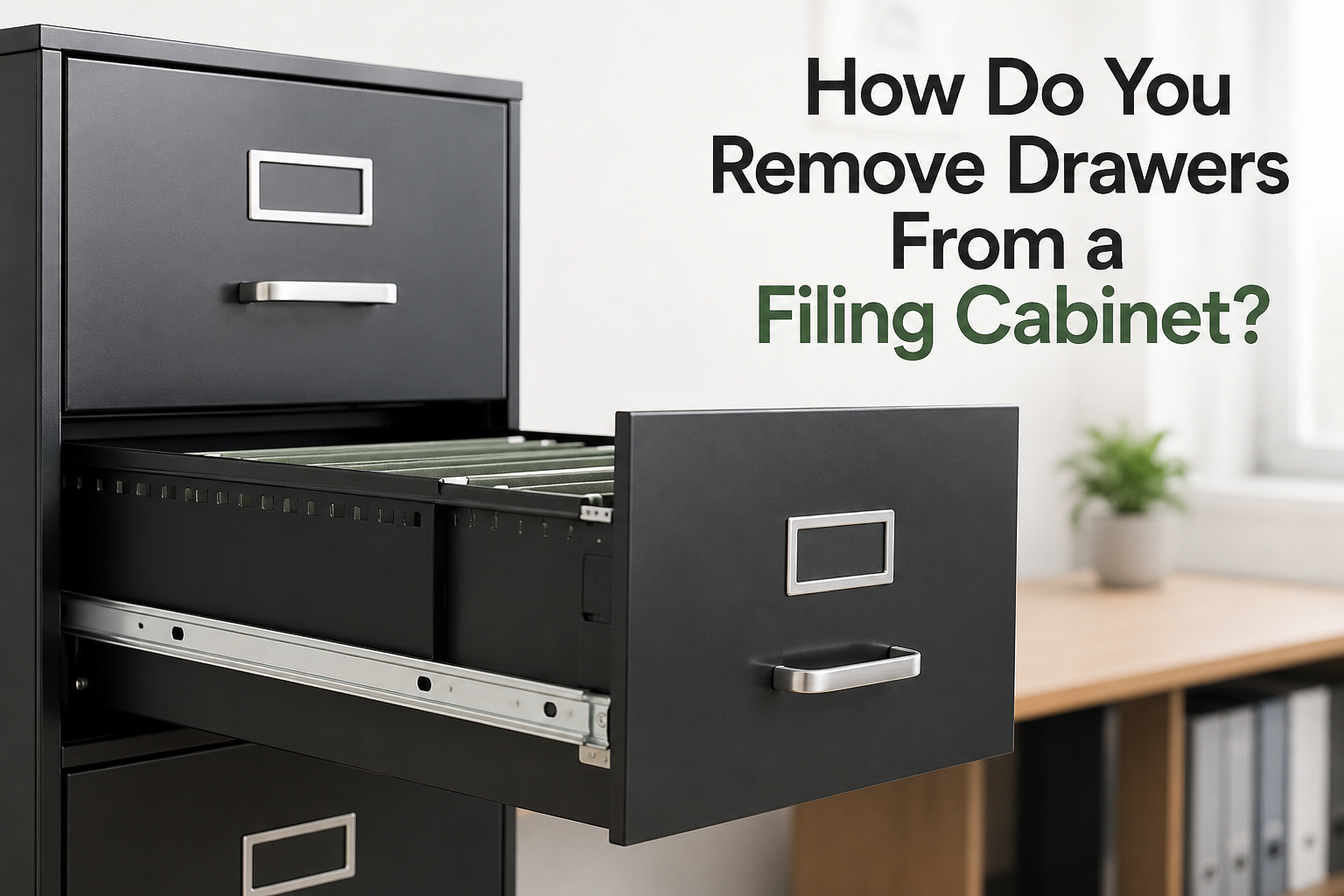
Lever or tab release. This is the most common type. Pull the drawer all the way out until it stops, then look along the inside of the slide rail for a small metal or plastic lever. Press it down, up, or inward (it varies by brand) while pulling the drawer free.
Push-button latch. Some cabinets use a single button on the slide itself. Press it and the drawer disconnects right away, according to Manutan’s breakdown of filing cabinet types.
Ball-bearing rollers or friction slides. Cheaper cabinets, or ones rated for lighter loads, often just rely on friction. Pull firmly and steadily, wiggling side to side if there’s resistance, and the drawer will come free on its own.
Screw-mounted rails. Older wooden or lateral cabinets sometimes have a visible screw near the front of each rail. Remove it with a screwdriver before the drawer will slide out.
Step-by-Step: Removing a Standard Filing Cabinet Drawer
For most cabinets, you’ll pull the drawer out fully, trigger the release lever on both sides, then lift and slide the drawer free of the rails.
- Empty the drawer completely.
- Pull it out until it stops moving on its own.
- Look along both side rails for a lever, tab, or button.
- Press or lift the release on both sides at the same time.
- Tilt the front of the drawer slightly and pull it forward, off the rails.
- Set it down somewhere flat and out of the walkway.
If the drawer resists, don’t force it. A gentle side-to-side wiggle while pulling usually clears minor snags.
How to Remove Drawers From a HON or Lateral Filing Cabinet
HON cabinets, common in offices, use a similar lever system but often hide the tab where the front and back rail sections meet. Empty the drawer, pull it fully open, then look for a black tab on each side near that joint and press both at once, as Hunker explains in its HON-specific guide.
Lateral cabinets, which are wider and shorter than standard vertical ones, sometimes add an anti-tip interlock. This stops more than one drawer from opening at a time, so you may need to close one drawer before another will release.
What to Do If a Drawer Is Stuck or Won’t Release
If a drawer won’t come loose, check three things before you force it. First, look for a screw you missed near the front of the rail. Second, check for bent or dirty rails, since debris buildup is a common cause of sticking. Third, make sure no other drawer is open, since anti-tip mechanisms lock other drawers until the open one closes, according to Ace Office Systems’ guide to filing cabinet safety features.
A light spray of silicone lubricant on the rails often fixes minor sticking. Avoid oil-based lubricants, since they attract dust and make the problem worse over time. If the drawer still won’t move, stop and check for physical damage to the slide rather than pulling harder.
Putting the Drawers Back In Safely
When you’re ready to reinstall the drawers, reverse the order: bottom drawer first, top drawer last. This keeps the cabinet weighted low while you work.
Line up the drawer’s slide members with the rails inside the cabinet, then push the drawer in until you hear or feel the release levers click back into place. Test each drawer by opening and closing it once before moving on to the next.
Practical Takeaways
Removing a filing cabinet drawer is a five-minute job once you know your release type. Work top to bottom when taking drawers out, and bottom to top when putting them back, to keep the cabinet from tipping. If something jams, check for a hidden screw or debris before forcing it.
If you’re already in home-maintenance mode, you might also want our guides on cleaning a dishwasher, cleaning a microwave, or changing a tire.
FAQ
Do I need tools to remove a filing cabinet drawer? Usually not. Most cabinets release with a lever, tab, or push-button built into the slide. You’ll only need a screwdriver if your cabinet has screw-mounted rails, which is more common on older wooden models.
Which drawer should I remove first? Start with the top drawer and work your way down. This keeps the cabinet’s weight centered and low, reducing the risk of it tipping forward while drawers are open.
Why won’t my filing cabinet drawer come out? It’s usually a missed screw, dirty or bent rails, or an anti-tip mechanism that locks other drawers while one is open. Check all three before forcing the drawer.
Is it normal for a drawer to resist near the end when I pull it? Yes. Many cabinets have ball retainers or stops built in that create resistance right before release, so the drawer doesn’t fall out by accident during normal use.
How do I put the drawers back in correctly? Reinstall from the bottom up. Line up the slide members with the rails, push until the release levers click into place, and test each drawer before moving to the next.